
Indicators and tests: limewater, hydrogencarbonate, universal indicator and litmusSpec S6
In short
Indicators are substances that change colour to show a chemical change, and you must give the colour before and after. Limewater turns from colourless to milky with carbon dioxide. Hydrogencarbonate indicator is red at the level in air, yellow when carbon dioxide increases and purple when it decreases. Universal indicator gives the pH number; litmus shows only acid or alkali.
Indicators change colour to show a chemical change. You must know the colours for each one, and always give the colour before and after.
| Indicator | What it shows | Colours |
|---|---|---|
| Limewater | carbon dioxide | colourless → milky (cloudy white) when carbon dioxide is bubbled through |
| Hydrogencarbonate indicator | carbon dioxide concentration | red at the level in air; yellow when carbon dioxide increases; purple when carbon dioxide decreases |
| Universal indicator | pH (a number) | red/orange in acid, green at pH 7 (neutral), blue/purple in alkali |
| Litmus | acid or alkali | turns red in acid, blue in alkali |
Testing pH
- Add a few drops of universal indicator solution to the sample, or dip universal indicator paper into it.
- Compare the colour with the pH colour chart.
- Read off the pH number.
Litmus only tells you whether a solution is acidic or alkaline. Universal indicator gives the pH number, so it shows how strongly acidic or alkaline it is.
Where they are used
- Limewater: comparing inspired and expired air, and showing that yeast or germinating seeds respire.
- Hydrogencarbonate indicator: gas exchange in an aquatic plant in light and dark, or respiration of small organisms in a sealed tube.
- Universal indicator or litmus: the pH falling as lipase digests fat into fatty acids, or testing soil and water samples.
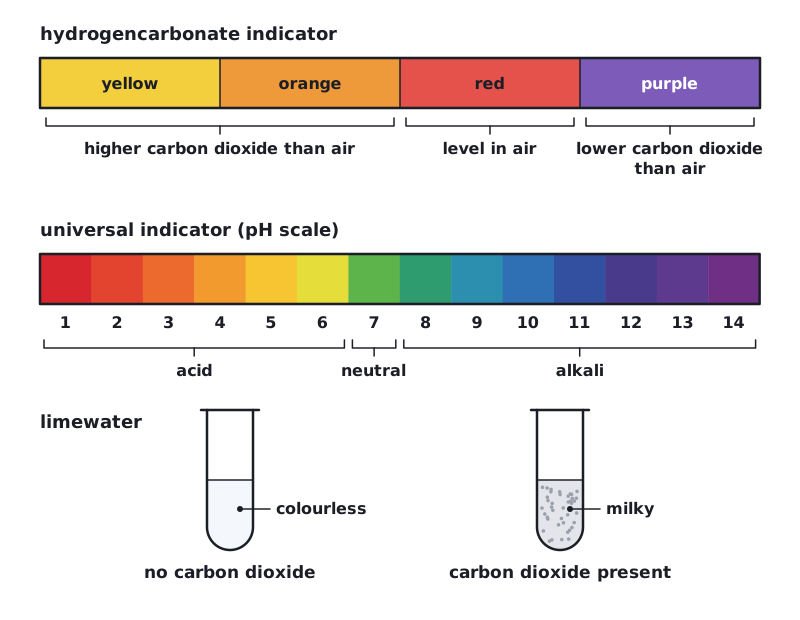 (opens full size in a new tab)
Food tests
| Test | For | Positive result |
|---|---|---|
| Iodine solution | starch | orange-brown → blue-black |
| Benedict's solution, heated in a water bath | reducing sugars | blue → green, yellow, orange or brick-red |
| Biuret test | proteins | blue → purple |
| Ethanol emulsion test | fats and oils | cloudy white emulsion |
| DCPIP | vitamin C | blue → colourless |
Wear eye protection for all these tests. Heat Benedict's in a water bath, not over a flame, and keep ethanol away from flames because it is flammable.
Quick check
How should a column heading for time in seconds be written?
Show answer
time / s
Which variable goes on the x-axis?
Show answer
The independent variable, unless told otherwise.
State the formula for magnification.
Show answer
magnification = image size ÷ actual size
What colour does hydrogencarbonate indicator turn when carbon dioxide increases?
Show answer
Yellow (from red).
A balance reads 0.3 g with nothing on it. What is this, and how do you correct for it?
Show answer
A zero error (a systematic error). Subtract 0.3 g from every reading.
Two results are 40 s and 43 s. Are they equal within the limits of experimental accuracy?
Show answer
Yes. 10% of 40 s is 4 s, so any result from 36 s to 44 s counts as equal.
Written and checked against the Cambridge IGCSE Combined Science (0653) specification · Updated October 2026