
DiffusionSpec B3.1.1, B3.1.2, B3.1.3
In short
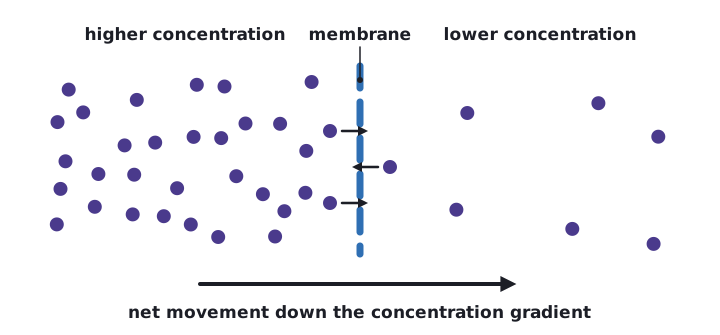
Diffusion is the net movement of particles from a region of higher concentration to a region of lower concentration, down a concentration gradient.
Particles in a gas or in a solution are always moving in random directions. This random movement spreads the particles out. The result is diffusion.
- Diffusion
- The net movement of particles from a region of their higher concentration to a region of their lower concentration (i.e. down a concentration gradient), as a result of their random movement.
 (opens full size in a new tab)
Some substances move into and out of cells by diffusion through the cell membrane. Small molecules such as oxygen, carbon dioxide and water can pass through easily.
Why diffusion is important
- Oxygen diffuses into cells for aerobic respiration, and carbon dioxide diffuses out as a waste product.
- In a leaf, carbon dioxide diffuses into the cells for photosynthesis and oxygen diffuses out.
- Digested food molecules (solutes) diffuse from the gut into the blood.
- Urea, a waste solute, diffuses out of cells into the blood plasma to be excreted.
Always write 'net movement' and 'down a concentration gradient'. Particles move in both directions, but more move from the region of higher concentration.
Do not say that particles 'want' to spread out or that the cell 'pulls' them in. Diffusion is passive: it only depends on random movement.
Written and checked against the Cambridge IGCSE Combined Science (0653) specification · Updated October 2026