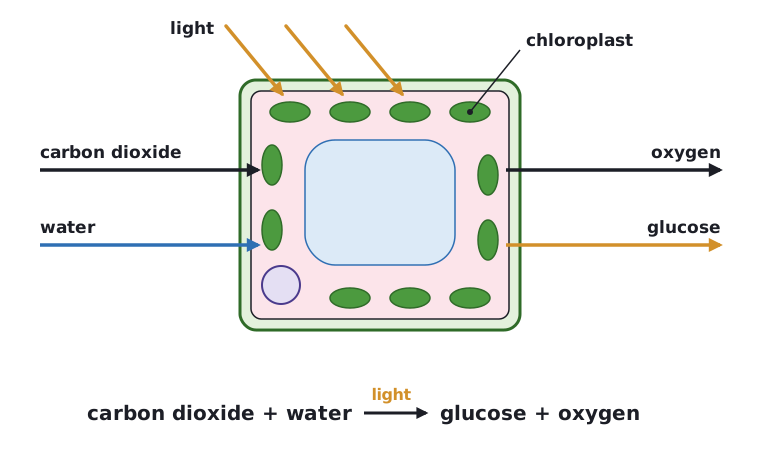
Photosynthesis is the reaction in which plants use carbon dioxide and water to make glucose and oxygen: carbon dioxide + water → glucose + oxygen. It happens in the chloroplasts, which contain chlorophyll. It is an endothermic reaction, because energy is transferred from the environment to the chloroplasts by light, so it needs a constant supply of light.
Plants make their own food by photosynthesis. In plants it happens in the chloroplasts, which contain the green pigment chlorophyll.
Photosynthesis is represented by the equation:
carbon dioxide + water → glucose + oxygen (in the presence of light)
6CO₂ + 6H₂O → C₆H₁₂O₆ + 6O₂ (in the presence of light)
Chemical symbols to recognise
Substance
Symbol
Carbon dioxide
CO₂
Water
H₂O
Glucose
C₆H₁₂O₆
Oxygen
O₂
Photosynthesis is an endothermic reaction. Energy is transferred from the environment to the chloroplasts by light. This is why the reaction needs a constant supply of light to keep going.
In an endothermic reaction, energy is taken in from the surroundings. The energy ends up stored in the glucose that is made.
Exam tip:
Reactants (carbon dioxide and water) go on the left and products (glucose and oxygen) on the right. Write light above the arrow, because it is not a reactant.
Common mistake:
Do not write light as a reactant. Say that energy is transferred from the environment to the chloroplasts by light.
Written and checked against the AQA GCSE Combined Science (8464) specification · Updated October 2026
Frequently asked questions
What are the limiting factors of photosynthesis?
The limiting factors of photosynthesis are light intensity, carbon dioxide concentration, temperature and the amount of chlorophyll. A limiting factor is the one in short supply, so it limits the rate. Increasing a different factor makes no difference until the limiting factor is increased. Which factor is limiting can change as conditions change.
How does light intensity affect the rate of photosynthesis?
Increasing light intensity increases the rate of photosynthesis, because light provides the energy for the reaction. The rate rises up to a point, then levels off when light is no longer the limiting factor and another factor, such as carbon dioxide concentration or temperature, is in short supply. In the pondweed practical, a closer lamp gives more bubbles.
How does temperature affect the rate of photosynthesis?
The rate of photosynthesis increases as temperature increases, up to an optimum. Photosynthesis is controlled by enzymes, and warmer particles move faster and collide more often. Above the optimum temperature the enzymes denature, so the rate drops quickly. In the pondweed practical, the water temperature is kept steady so that it does not affect the results.

 (opens full size in a new tab)