
The lungs and gas exchangeSpec 4.2.2.2
In short
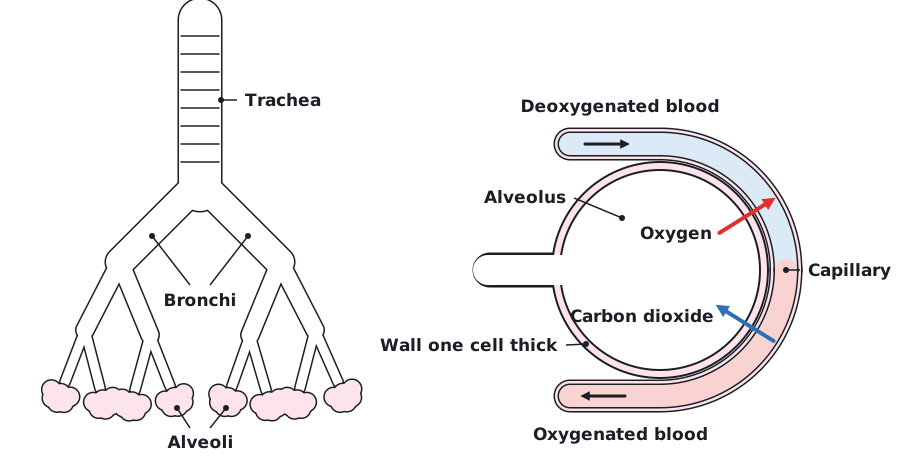
Gas exchange in the lungs happens at the alveoli. Air passes down the trachea into two bronchi, which branch into tubes ending in alveoli. Oxygen diffuses into the blood in the surrounding capillaries and carbon dioxide diffuses out. Millions of alveoli give a large surface area, and their walls are one cell thick, giving a short diffusion distance.
You need to know the structure of the lungs and how they are adapted for gaseous exchange. Knowledge of the lungs is restricted to the trachea, bronchi, alveoli and the capillary network surrounding the alveoli.
- Air passes down the trachea.
- The trachea divides into two bronchi, one to each lung.
- The bronchi branch into smaller tubes that end in alveoli (air sacs).
- At the alveoli, oxygen diffuses into the blood in the surrounding capillaries and carbon dioxide diffuses out of the blood into the air.
Blood arriving at the lungs has a low concentration of oxygen and a high concentration of carbon dioxide. Oxygen therefore diffuses from the air in the alveoli into the blood, and carbon dioxide diffuses the other way.
| Adaptation | Why it helps |
|---|---|
| Millions of alveoli | Gives a very large surface area for diffusion |
| Walls one cell thick | Short diffusion distance, so gases cross quickly |
| Surrounded by a network of capillaries (a good blood supply) | Blood carries oxygen away and brings carbon dioxide, which keeps a steep concentration gradient |
| Constantly ventilated by breathing | Fresh air keeps the oxygen concentration high in the alveoli, which also keeps a steep concentration gradient |
 (opens full size in a new tab)
In gas exchange answers, link each feature to its effect: ‘thin wall, so short diffusion distance’ earns the mark. Naming the feature alone does not.
Written and checked against the AQA GCSE Combined Science (8464) specification · Updated October 2026