
FossilsSpec 4.6.3.5
In short
Fossils are the remains of organisms from millions of years ago, found in rocks. They form from parts of organisms that have not decayed, from parts replaced by minerals as they decay, or as preserved traces such as footprints and burrows. The fossil record is incomplete because many early life forms were soft-bodied and geological activity destroyed most traces.
Fossils are the 'remains' of organisms from millions of years ago, which are found in rocks.
How fossils may form
- From parts of organisms that have not decayed because one or more of the conditions needed for decay are absent.
- When parts of the organism are replaced by minerals as they decay.
- As preserved traces of organisms, such as footprints, burrows and rootlet traces.
We can learn from fossils how much or how little different organisms have changed as life developed on Earth.
Why the fossil record is incomplete
Many early forms of life were soft-bodied, which means that they have left few traces behind. What traces there were have been mainly destroyed by geological activity. This is why scientists cannot be certain about how life began on Earth.
Evolutionary trees
You may need to extract and interpret information from charts, graphs and tables, such as evolutionary trees. Evolutionary trees use fossil data for extinct organisms and current classification data for living organisms.
Fossils are evidence for how organisms have changed over time, but gaps mean the record is incomplete. Quote both ideas in an evaluation.
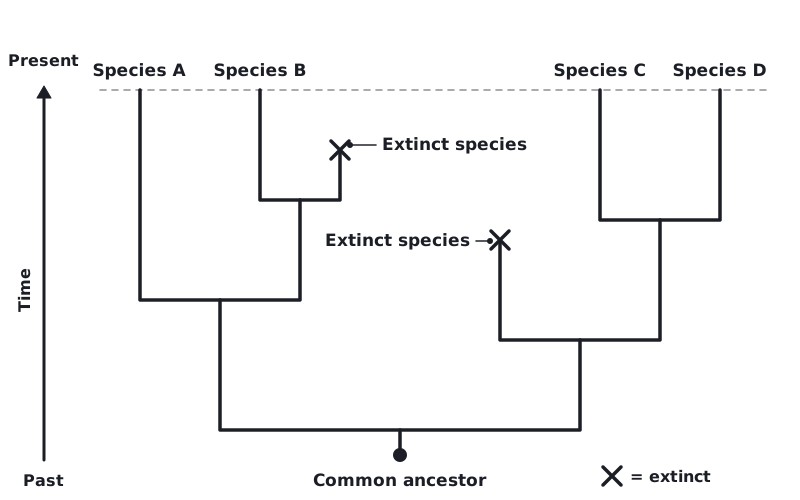 (opens full size in a new tab)
Written and checked against the AQA GCSE Combined Science (8464) specification · Updated October 2026