
Transpiration and stomataSpec 4.2.3.2
In short
Transpiration is the loss of water vapour from the leaves. It draws water from the roots up through the xylem in a continuous transpiration stream. Water evaporates from the mesophyll cells and diffuses out through stomata, which are pores mainly on the underside of the leaf. Guard cells open and close the stomata to control gas exchange and water loss.
Transpiration is the loss of water vapour from the leaves. Water moves from the roots to the leaves in the xylem in a continuous flow called the transpiration stream.
- Water enters the root hair cells by osmosis.
- Water moves up through the xylem to the leaves.
- Water evaporates from the surface of the mesophyll cells into the air spaces in the leaf.
- Water vapour diffuses out of the leaf through the stomata.
The transpiration stream brings water and mineral ions to the leaves. Leaf cells need water and carbon dioxide for photosynthesis.
Stomata and guard cells
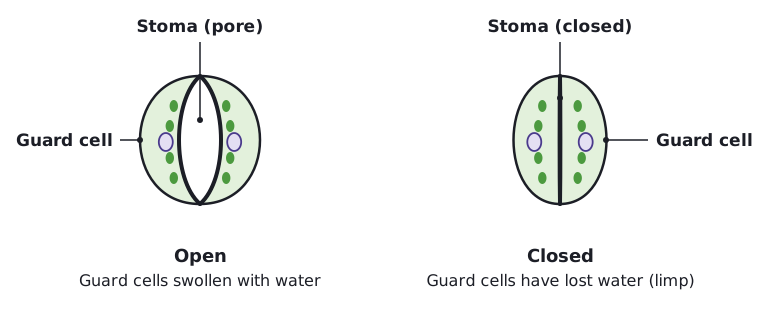
Stomata are small pores, mainly on the underside of the leaf. Each is surrounded by a pair of guard cells. The role of stomata and guard cells is to control gas exchange and water loss.
- When the guard cells take in water they swell and the stoma opens. Carbon dioxide can diffuse in for photosynthesis and oxygen can diffuse out. Water vapour is also lost.
- When the guard cells lose water the stoma closes, which reduces water loss.
There is a trade-off. Closing the stomata saves water but stops carbon dioxide getting in, so photosynthesis slows down.
Transpiration is the loss of water vapour from the leaves. Translocation is the movement of sugars in the phloem. Do not mix them up.
 (opens full size in a new tab)
Written and checked against the AQA GCSE Combined Science (8464) specification · Updated October 2026