
Factors that affect the rate of photosynthesisSpec 4.4.1.2
In short
The rate of photosynthesis is affected by four factors: light intensity, carbon dioxide concentration, temperature and the amount of chlorophyll. The one in short supply is the limiting factor, and raising other factors makes no difference until it is increased. Above the optimum temperature, the enzymes denature. Rate = volume of oxygen produced ÷ time.
Four factors affect the rate of photosynthesis. If one of them is in short supply, it limits the rate. Raising any other factor will make no difference until the limiting factor is increased.
| Factor | Effect on rate | Why |
|---|---|---|
| Light intensity | Rate increases as light intensity increases, up to a point | Light provides the energy for the reaction. When light is no longer the limiting factor, the rate levels off. |
| Carbon dioxide concentration | Rate increases as concentration increases, up to a point | Carbon dioxide is a reactant. When it is no longer limiting, the rate levels off. |
| Temperature | Rate increases as temperature increases up to an optimum, then falls | Photosynthesis is controlled by enzymes. Warmer particles move faster and collide more often. Above the optimum, the enzymes denature and the rate drops quickly. |
| Amount of chlorophyll | Less chlorophyll means a lower rate | Chlorophyll absorbs the light. Fewer chloroplasts or damaged leaves (for example from disease) absorb less light. |
When explaining a graph that levels off, say that the factor on the x-axis is no longer limiting and that something else is now in short supply. Name the other factor if the question allows.
Measuring and calculating the rate
You can measure the rate of photosynthesis by finding how much oxygen is made, or how many bubbles are released, in a set time. The bigger the volume or number of bubbles, the faster the rate.
Calculating a rate
A piece of pondweed produced 24 cm³ of oxygen in 8 minutes. Calculate the rate of photosynthesis in cm³ per minute.
- rate = volume ÷ time
- rate = 24 ÷ 8
Answer: 3 cm³ per minute
Rearranging the equation
A different piece of pondweed photosynthesises at 2.5 cm³ per minute. How long will it take to produce 15 cm³ of oxygen?
- rate = volume ÷ time, so time = volume ÷ rate
- time = 15 ÷ 2.5
Answer: 6 minutes
Always include units in a rate. Here the unit is cm³ per minute (cm³/min).
Plotting and reading graphs
- Put the factor you change (the independent variable) on the x-axis and the rate on the y-axis.
- Choose a scale that uses more than half of the grid, with equal steps on each axis.
- Label both axes with the quantity and the unit.
- Plot the points accurately and draw a smooth line or curve of best fit.
- To read a graph, find the value on one axis and follow it across to the line, then down or across to the other axis. You can then write the values in a table, or draw a graph from a table.
For a graph with one limiting factor, the rate rises steeply, then curves over and becomes flat. In the rising part the factor on the x-axis is limiting. In the flat part another factor is limiting.
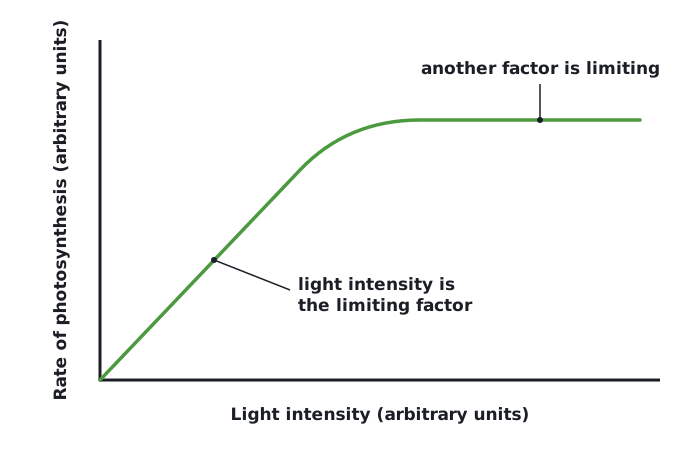 (opens full size in a new tab)
Written and checked against the AQA GCSE Combined Science (8464) specification · Updated October 2026