
Hormones in human reproductionSpec 4.5.3.4
In short
Reproductive hormones cause secondary sex characteristics to develop during puberty. Oestrogen, made by the ovary, is the main female reproductive hormone. Testosterone, made by the testes, is the main male reproductive hormone and stimulates sperm production. In the menstrual cycle, FSH causes an egg to mature, LH stimulates its release, and oestrogen and progesterone maintain the uterus lining.
During puberty, reproductive hormones cause secondary sex characteristics to develop.
| Hormone | Made by | Role |
|---|---|---|
| Oestrogen | The ovary | The main female reproductive hormone |
| Testosterone | The testes | The main male reproductive hormone. It stimulates sperm production |
At puberty eggs begin to mature in the ovaries, and one is released approximately every 28 days. This is called ovulation.
Hormones in the menstrual cycle
| Hormone | Role in the menstrual cycle |
|---|---|
| Follicle stimulating hormone (FSH) | Causes maturation of an egg in the ovary |
| Luteinising hormone (LH) | Stimulates the release of the egg |
| Oestrogen and progesterone | Involved in maintaining the uterus lining |
Higher tier (what this means)
Higher tier: only on the Higher tier papers. Foundation students can skip it. What the labels meanHow the hormones interact
Higher tier (what this means)
Higher tier: only on the Higher tier papers. Foundation students can skip it. What the labels mean- FSH is released by the pituitary gland. It causes an egg to mature in the ovary. It also stimulates the ovary to release oestrogen.
- Oestrogen causes the lining of the uterus to grow and repair. It inhibits the release of FSH. When oestrogen reaches a high level it stimulates the pituitary gland to release a surge of LH.
- LH stimulates the release of the egg (ovulation), around the middle of the cycle.
- Progesterone maintains the lining of the uterus. It inhibits the release of FSH and LH.
- If progesterone falls, the uterus lining breaks down and the next cycle starts.
Higher tier (what this means)
Higher tier: only on the Higher tier papers. Foundation students can skip it. What the labels mean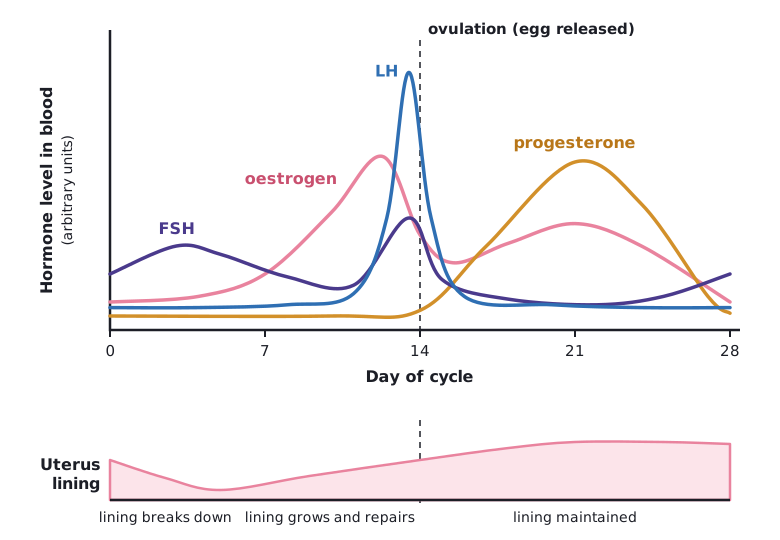 (opens full size in a new tab)
Higher tier (what this means)
Higher tier: only on the Higher tier papers. Foundation students can skip it. What the labels meanReading a hormone graph
A graph shows LH peaking sharply at day 14, and progesterone rising to its highest level at day 21 and falling by day 28. State what happens at day 14 and explain what the fall in progesterone at day 28 causes.
- The LH peak at day 14 matches ovulation: LH stimulates the release of the egg.
- Progesterone helps to maintain the uterus lining.
- When progesterone falls, the lining can no longer be maintained.
Answer: An egg is released at day 14. The fall in progesterone at day 28 causes the uterus lining to break down.
Higher tier (what this means)
Higher tier: only on the Higher tier papers. Foundation students can skip it. What the labels meanOn hormone graphs, read the day number and the line together. Say what happens (a peak, a rise, a fall), name the hormone, then link it to the event in the cycle.
FSH is not the hormone that releases the egg. FSH makes the egg mature; LH stimulates its release.
Written and checked against the AQA GCSE Combined Science (8464) specification · Updated October 2026