
Blood vesselsSpec 4.2.2.2
In short
Arteries carry blood away from the heart at high pressure, so they have thick walls with muscle and elastic fibres. Veins carry blood back to the heart at low pressure and have thinner walls, a wide lumen and valves to stop backflow. Capillaries have walls one cell thick, giving a short diffusion distance for exchanging substances with body cells.
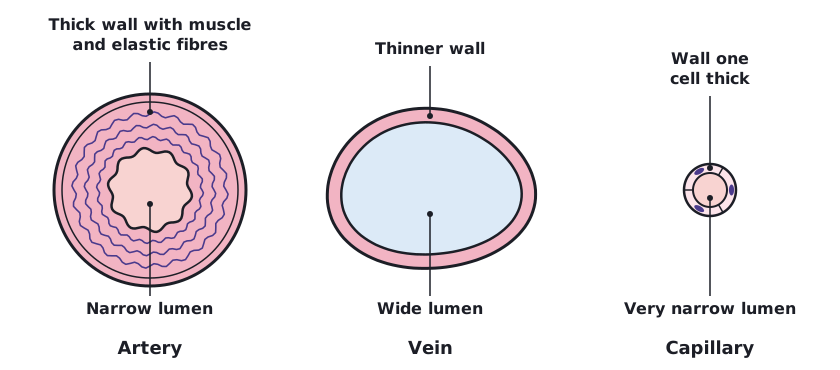
The body contains three different types of blood vessel: arteries, veins and capillaries. Their structures are related to their functions.
| Artery | Vein | Capillary | |
|---|---|---|---|
| Function | Carries blood away from the heart at high pressure | Carries blood back to the heart at low pressure | Exchanges substances with body cells |
| Wall | Thick, with muscle and elastic fibres | Thinner walls | One cell thick, so substances pass through easily |
| Lumen (inside space) | Narrow compared with the thickness of the wall | Wide | Very narrow |
| Valves | No | Yes, to stop backflow | No |
Arteries have thick, strong walls because the blood is at high pressure. The elastic fibres let the wall stretch and spring back. The muscle strengthens the wall.
Veins have a wide lumen and valves. The blood is at low pressure, so the valves stop it flowing backwards.
Capillaries are tiny and have very thin walls. This gives a short diffusion distance, so oxygen and nutrients can pass to the cells and carbon dioxide and waste can pass back into the blood. Capillary walls are permeable.
Blood flow rate
Calculating blood flow
300 cm³ of blood flows through an artery in 4 minutes. Calculate the rate of blood flow in cm³ per minute.
- Rate = volume ÷ time.
- Rate = 300 ÷ 4.
Answer: 75 cm³/min
A rate is always something per unit time. Make sure your answer has units such as cm³/min, and that the time is in the unit you are asked for.
 (opens full size in a new tab)
Written and checked against the AQA GCSE Combined Science (8464) specification · Updated October 2026