
Energy transfer and the 10% ruleSpec 4.8, 4.9
In short
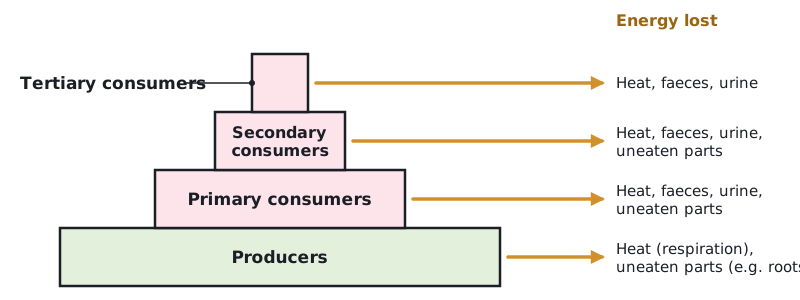
Only about 10% of the energy at one trophic level is transferred to the next. The rest is lost: not all of the organism is eaten, some food is not digested and is lost in faeces, energy released by respiration is transferred to the surroundings as heat, and some is lost in urine. So food chains are limited in length.
Producers absorb only a small part of the light energy that reaches them. The energy stored in their biomass is passed along the food chain, together with the substances (such as carbon compounds) that make up the biomass, when each organism is eaten by the next.
Energy is not passed on completely. Only about 10% of the energy is transferred from one trophic level to the next. The rest is lost, for these reasons:
- not all of the organism is eaten (for example bones, roots or hair), and some of what is eaten is not digested and is lost in faeces;
- energy is released by respiration and transferred to the surroundings as heat;
- energy is used for movement and for keeping warm in mammals and birds;
- energy is lost in waste such as urine.
Percentage of energy transferred
The grass in a field stores 20 000 kJ of energy. The rabbits that eat the grass gain 1800 kJ. Calculate the percentage of energy transferred from the grass to the rabbits.
- Energy transferred = 1800 kJ.
- Energy available = 20 000 kJ.
- Percentage = 1800 ÷ 20 000 × 100 = 9%.
Answer: 9%
This has two effects. Less energy and biomass is available at each higher trophic level, so pyramids of biomass and energy narrow at each level. Food chains are limited in length, usually to four or five trophic levels, because there is too little energy left to support more.
Do not say that energy is used up. Say that it is transferred to the surroundings as heat, or to less useful forms, or lost in waste.
 (opens full size in a new tab)
Quick check
What number trophic level are producers?
Show answer
Level 1.
Name the organisms that break down dead material.
Show answer
Decomposers.
What do the arrows in a food chain show?
Show answer
The direction food and energy pass, from the food to the organism that eats it.
What percentage of energy is transferred to the next trophic level?
Show answer
About 10%.
Why are food chains limited in length?
Show answer
Too little energy is left to support more trophic levels.
Written and checked against the Edexcel IGCSE Science Double Award (4SD0) specification · Updated October 2026