
Book a tutor

The placenta and amniotic fluid

Reproduction and inheritance · Human reproduction · note 3 of 4

The placenta and amniotic fluidSpec 3.11, 3.12

In short

The placenta is a disc-shaped organ that attaches the embryo to the uterus wall. Oxygen and nutrients diffuse from the mother's blood into the embryo's blood, and carbon dioxide and urea diffuse the other way, without the bloods mixing. Villi give a large surface area. Amniotic fluid in the amnion protects the embryo by absorbing shocks.

After the embryo implants in the uterus lining, the placenta grows. It is a disc-shaped organ that attaches the embryo to the uterus wall. The embryo is joined to the placenta by the umbilical cord, which contains blood vessels.

The role of the placenta

The mother's blood and the embryo's blood flow close together in the placenta, but they do not mix. Substances pass between them by diffusion.

  • Oxygen and nutrients (such as glucose and amino acids) diffuse from the mother's blood into the embryo's blood. This provides the embryo with its nutrition.
  • Carbon dioxide and urea diffuse from the embryo's blood into the mother's blood, to be removed.
  • The placenta has many villi. These give a large surface area for exchange, so more substances can diffuse. A good blood supply and thin walls also make diffusion faster.

Amniotic fluid

The embryo develops inside a bag called the amnion. The amnion is filled with amniotic fluid. The fluid protects the developing embryo by absorbing shocks and cushioning it against knocks and bumps to the mother's abdomen.
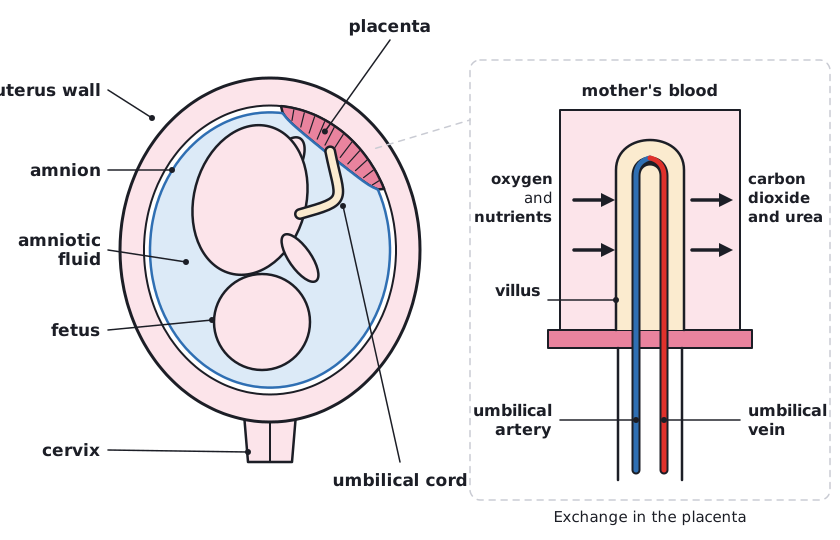
Section through a pregnant uterus showing the uterus wall, placenta, umbilical cord, fetus, amnion, amniotic fluid and cervix, with an enlarged villus in the mother's blood: oxygen and nutrients pass into the villus and carbon dioxide and urea pass out; the umbilical artery and umbilical vein run through the cord. (opens full size in a new tab)
Oxygen and nutrients diffuse from the mother's blood into the fetus's blood across the placenta; carbon dioxide and urea diffuse the other way.
Common mistake:

The mother's blood and the embryo's blood do not mix. Substances move between them by diffusion across the placenta.

Written and checked against the Edexcel IGCSE Science Double Award (4SD0) specification · Updated October 2026

Frequently asked questions

What are the roles of oestrogen and progesterone in the menstrual cycle?

Oestrogen and progesterone are both made in the ovaries. Oestrogen causes the repair and growth of the uterus lining after menstruation. Progesterone maintains the thick lining, ready for a fertilised egg. If the egg is not fertilised, progesterone falls, the lining is no longer maintained and it breaks down in menstruation.

How does the placenta provide for the developing embryo?

The placenta lets substances pass between the mother's blood and the embryo's blood by diffusion, without the bloods mixing. Oxygen and nutrients such as glucose and amino acids diffuse into the embryo's blood, while carbon dioxide and urea diffuse into the mother's blood. Villi, thin walls and a good blood supply speed up diffusion.

Where does fertilisation happen in humans?

Fertilisation usually happens in the oviduct, the tube that carries the egg from the ovary to the uterus. Sperm are made in the testes, and eggs are made in the ovaries. Cilia lining the oviduct move the egg along, and the embryo then implants in the soft lining of the uterus.

All 4 questions on Human reproduction