
Leaf structure and adaptationsSpec 2.21, 2.42B
In short
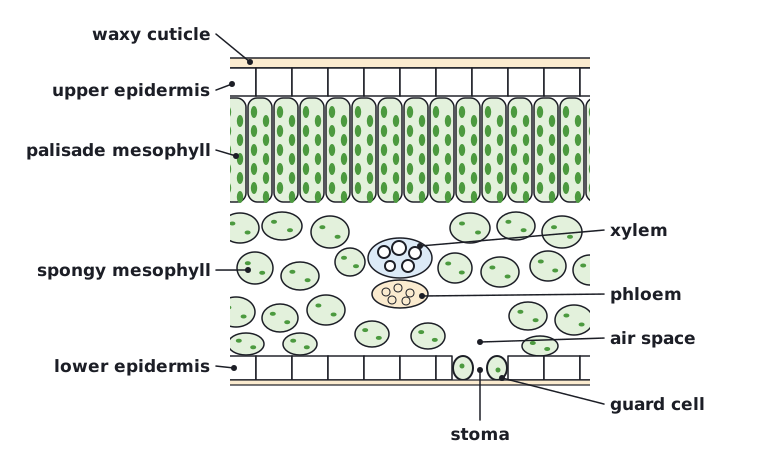
A leaf is adapted for photosynthesis and gas exchange. It is broad, flat and thin, giving a large surface area to absorb light and a short diffusion distance for gases. Most photosynthesis happens in the palisade mesophyll, whose cells contain many chloroplasts. Air spaces in the spongy mesophyll and stomata opened by guard cells let gases diffuse in and out.
A leaf is adapted to absorb light for photosynthesis and to allow gas exchange of carbon dioxide and oxygen.
| Structure | Adaptation | How it helps |
|---|---|---|
| Whole leaf | Broad, flat and thin | Large surface area to absorb light, and a short distance for gases to diffuse |
| Waxy cuticle | A waxy, waterproof layer on the surface | Reduces water loss by evaporation |
| Upper epidermis | A thin layer of transparent cells | Lets light through to the cells underneath |
| Palisade mesophyll | Tightly packed, tall cells near the top of the leaf, with many chloroplasts | Most photosynthesis takes place here, close to the light |
| Spongy mesophyll | Loosely arranged cells with air spaces between them | Carbon dioxide can diffuse through the leaf to the cells, and oxygen can diffuse out |
| Stomata and guard cells | Pores, mostly in the lower epidermis, opened and closed by guard cells | Allow gases to enter and leave, and control water loss |
| Xylem and phloem (veins) | Vascular bundles running through the leaf | Xylem brings water for photosynthesis. Phloem carries sucrose away. |
 (opens full size in a new tab)
Biology only (what this means)
Biology only: only in International GCSE Biology. Double Award students can skip it. What the labels meanHow the leaf is adapted for gas exchange
Biology only (what this means)
Biology only: only in International GCSE Biology. Double Award students can skip it. What the labels meanCarbon dioxide and oxygen move into and out of a leaf by diffusion, down their concentration gradients. The structure of the leaf makes this diffusion fast.
Biology only (what this means)
Biology only: only in International GCSE Biology. Double Award students can skip it. What the labels mean- Broad, flat shape: a large surface area for gases to diffuse in and out.
- Thin leaf: a short diffusion distance, so gases reach the cells quickly.
- Many stomata, mostly in the lower epidermis: pores that let carbon dioxide diffuse in and oxygen diffuse out. Guard cells open and close them.
- Air spaces in the spongy mesophyll: gases diffuse quickly between the stomata and the cells, and a large surface area of cells is exposed to the air.
- Moist cell surfaces: gases dissolve in the thin film of water on the mesophyll cells, then diffuse into or out of the cells.
Always give an adaptation and the reason it helps. For example, 'the air spaces in the spongy mesophyll allow carbon dioxide to diffuse to the photosynthesising cells'.
Written and checked against the Edexcel IGCSE Science Double Award (4SD0) specification · Updated October 2026