
Book a tutor

Trophic levels

Ecology and the environment · Feeding relationships · note 1 of 4

Trophic levelsSpec 4.6

In short

A trophic level is the position of an organism in a food chain. Producers, such as plants and algae, are level 1, primary consumers (herbivores) are level 2, secondary consumers are level 3 and tertiary consumers are level 4. Decomposers, which are bacteria and fungi, secrete enzymes onto dead matter and waste, and the small soluble molecules diffuse in.

A trophic level is the position of an organism in a food chain. Trophic levels are numbered, starting at level 1 with the producers. Further levels are numbered according to how far the organism is along the food chain.

Trophic levelOrganismsName
Level 1Plants and algae make their own foodProducers
Level 2Herbivores eat the producersPrimary consumers
Level 3Carnivores that eat herbivoresSecondary consumers
Level 4Carnivores that eat other carnivoresTertiary consumers

Decomposers

Decomposers break down dead plant and animal matter and waste by secreting enzymes into the environment. Small soluble food molecules then diffuse into the microorganism. Decomposers are bacteria and fungi.
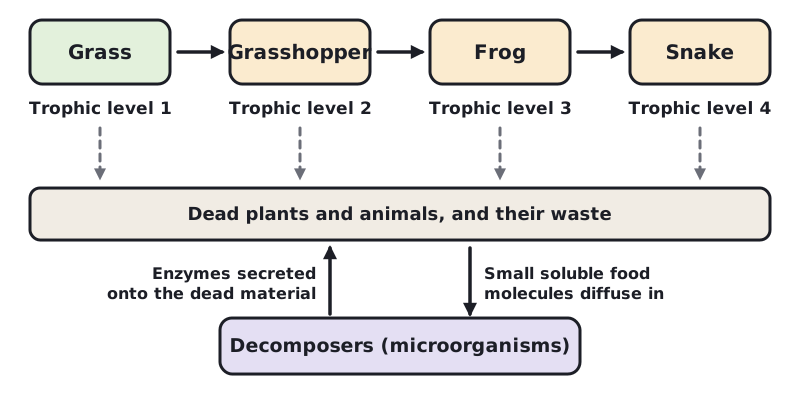
Food chain of grass, grasshopper, frog and snake labelled trophic levels 1 to 4, with dashed arrows from each to dead plants and animals and their waste; below, decomposers (microorganisms) secrete enzymes onto the dead material and small soluble food molecules diffuse into them. (opens full size in a new tab)
Every trophic level ends up as dead material or waste. Decomposers secrete enzymes onto it, then the small soluble molecules diffuse in.
Exam tip:

Decomposers secrete enzymes outside their bodies, onto the dead material. They do not take in the dead material and then digest it.

Written and checked against the Edexcel IGCSE Science Double Award (4SD0) specification · Updated October 2026

Frequently asked questions

Why is energy lost between trophic levels?

Energy is lost between trophic levels because not all of an organism is eaten, and some of what is eaten is not digested and is lost in faeces. Energy is also released by respiration and transferred to the surroundings as heat, used for movement and keeping warm, and lost in waste such as urine.

What is a pyramid of biomass?

A pyramid of biomass is a diagram whose bars show the mass of living material at each trophic level, with producers at the bottom. It almost always narrows at each higher level, because energy and biomass are lost at every step. Unlike a pyramid of number, it accounts for size, so one large oak tree gives a wide base.

Why are food chains short?

Food chains are short, usually four or five trophic levels, because only about 10% of the energy is transferred from one level to the next. The rest is lost as heat from respiration, in faeces and in waste. After a few levels, too little energy is left to support another population of organisms.

All 5 questions on Feeding relationships