
Practical: anaerobic respiration in yeastSpec 5.6
In short
This practical measures the rate of anaerobic respiration in yeast from the volume of carbon dioxide made in a set time. Yeast is mixed with boiled, cooled sugar solution under a layer of oil to keep oxygen out. The rate rises with temperature up to an optimum of about 35–40 °C, then falls as enzymes denature.
In this practical you investigate how conditions, such as temperature or the type or concentration of sugar, affect the rate of anaerobic respiration in yeast. The rate is measured from the carbon dioxide produced.
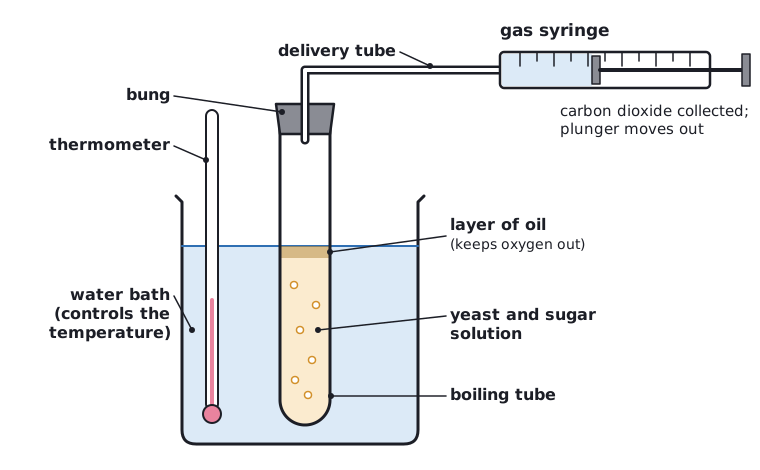
Investigating the effect of temperature on anaerobic respiration in yeast. The same method can be used with different sugars or sugar concentrations as the independent variable.
- Boil the sugar solution and let it cool, to remove dissolved oxygen. (It must be cool, or it would kill the yeast.)
- Mix yeast with the sugar solution in a boiling tube. Add a layer of oil on top to stop oxygen getting back in, so the yeast respires anaerobically.
- Attach a delivery tube to a gas syringe, or run it into water so the bubbles can be counted.
- Stand the tube in a water bath at the first temperature, for example 20 °C. Leave it to reach that temperature.
- Measure the volume of gas collected, or count the bubbles, in a set time such as 5 minutes.
- Repeat at other temperatures, such as 30, 40, 50 and 60 °C, and repeat each temperature to calculate a mean.
 (opens full size in a new tab)
| Type of variable | What it is |
|---|---|
| Independent | The condition changed, for example temperature |
| Dependent | The volume of gas collected, or bubbles counted, in a set time |
| Control | Mass or volume of yeast, volume and concentration of sugar solution, type of sugar, time allowed for each reading, depth of the oil layer |
Safety: wear eye protection, take care with hot water, and wash your hands after handling the yeast. Tie back long hair.
Expected results: the rate is slow at low temperatures. It increases as the temperature rises towards an optimum, usually about 35–40 °C, because the enzymes work faster. Above the optimum the rate falls, because the enzymes are denatured. You can confirm the gas is carbon dioxide by bubbling it through limewater, which turns cloudy.
Name the control variables and say how they are kept the same. Measuring in a fixed time lets you calculate a rate, such as bubbles per minute. A gas syringe is more accurate than counting bubbles, because bubbles can be different sizes.
Written and checked against the Edexcel IGCSE Science Double Award (4SD0) specification · Updated October 2026