
Why multicellular organisms need transport systemsSpec 2.51, 2.52
In short
Multicellular organisms need transport systems because their surface area to volume ratio is small and most of their cells are deep inside the body. Diffusion over these long distances is too slow to supply oxygen and food or to remove waste. A unicellular organism has a large surface area to volume ratio, so diffusion alone is enough.
Every cell needs a supply of oxygen and dissolved food molecules, and must get rid of waste such as carbon dioxide. In a unicellular (single-celled) organism these substances move in and out by diffusion across the cell surface.
This works because a single cell has a large surface area compared with its volume. No part of the cell is far from the surface, so the diffusion distance is short and diffusion is fast enough to meet the cell's needs.
Multicellular organisms
A multicellular organism is much bigger. Its surface area : volume ratio is small, and most of its cells are deep inside the body, far from the outside world. Diffusion over such long distances is far too slow to supply every cell with enough oxygen and food, or to remove waste quickly enough.
Multicellular organisms therefore need a transport system. In humans this is the blood in the circulatory system. In flowering plants it is the xylem and phloem.
Surface area : volume ratio of a cube
A cube-shaped block of tissue has sides of 3 cm. Calculate its surface area : volume ratio.
- A cube has 6 faces. Area of one face = 3 × 3 = 9 cm².
- Surface area = 6 × 9 = 54 cm².
- Volume = 3 × 3 × 3 = 27 cm³.
- Ratio = 54 : 27. Divide both sides by 27.
Answer: 2 : 1
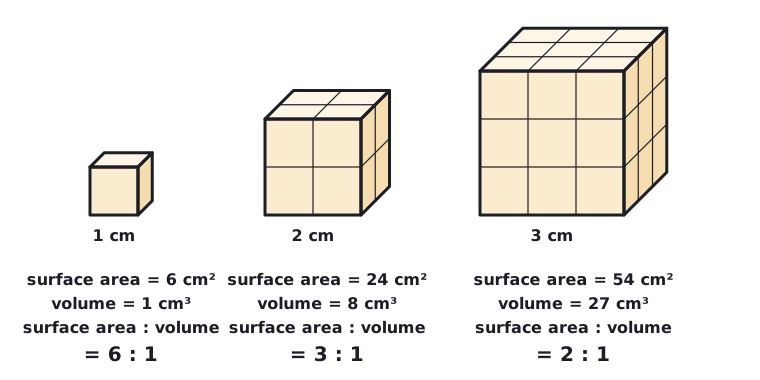 (opens full size in a new tab)
| Substance | Direction | Reason |
|---|---|---|
| Oxygen | Into cells | Used in aerobic respiration to release energy |
| Carbon dioxide | Out of cells | Waste product of respiration |
| Digested food (glucose, amino acids) | Into cells | Source of energy and materials for growth and repair |
| Urea | Out of cells | Waste product made in the body, removed in urine |
Do not just say that large organisms 'need more oxygen'. Link the idea: small surface area : volume ratio, so a long diffusion distance, so diffusion alone is too slow.
Written and checked against the Edexcel IGCSE Science Double Award (4SD0) specification · Updated October 2026