
The structure of DNASpec 3.4
In short
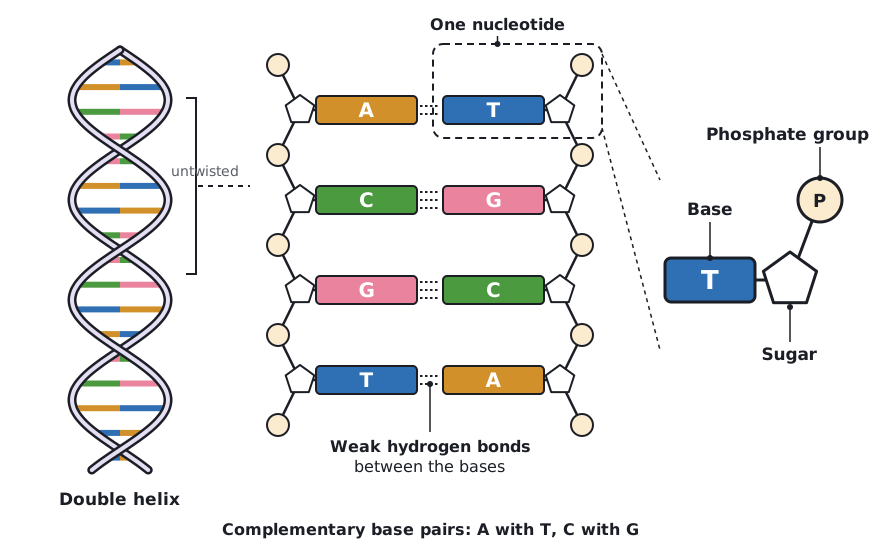
DNA is a polymer made of repeating units called nucleotides. Each nucleotide has a sugar, a phosphate group and one of four bases. Two strands coil into a double helix and are linked by complementary base pairs, joined by weak hydrogen bonds: adenine (A) pairs with thymine (T), and cytosine (C) pairs with guanine (G).
DNA is a polymer made up of many repeating units called nucleotides. A polymer is a long molecule made of many similar smaller units joined together.
- DNA is made of two strands coiled to form a double helix.
- Each nucleotide consists of a sugar and a phosphate group, with one of four different bases attached to the sugar.
- The two strands are linked by a series of complementary base pairs, joined together by weak hydrogen bonds.
| Base | Pairs with |
|---|---|
| Adenine (A) | Thymine (T) |
| Thymine (T) | Adenine (A) |
| Cytosine (C) | Guanine (G) |
| Guanine (G) | Cytosine (C) |
Because A always pairs with T and C always pairs with G, the base sequence on one strand tells you the sequence on the other. If one strand reads A T G C, the complementary strand reads T A C G.
 (opens full size in a new tab)
The bonds between the two strands are weak hydrogen bonds. They are between the bases, not between the sugar and phosphate groups.
Written and checked against the Edexcel GCSE Combined Science (1SC0) specification · Updated October 2026