
Book a tutor

Stone tools

Natural selection and genetic modification · Evidence for evolution and classification · note 2 of 3

Stone toolsSpec 4.5

In short

Stone tools give evidence of how early humans lived, because stone survives for a very long time. The oldest tools are simple stones with a few chips knocked off, while later tools are more complex and specialised, suggesting greater skill and intelligence. Tools are dated from the age of the rock or sediment layer they are found in.

Early humans made tools from stone. Stone tools survive for a very long time, so they give evidence about how early humans lived and how their skills developed.

Development of stone tools over time

  • The oldest tools are very simple, such as stones with a few chips knocked off to make a sharp edge.
  • Over time tools became more complex and better made: more carefully shaped and more specialised for different jobs.
  • This suggests that early humans developed greater skill and intelligence, which fits with fossil evidence of larger brains.

Dating stone tools

Scientists can date stone tools from their environment. A tool is found in a layer of rock or sediment. The age of that layer, or of materials found with the tool such as volcanic ash, can be worked out. The tool is then taken to be about the same age as the layer it was found in. Layers are laid down one on top of another, so deeper layers are usually older.

Exam tip:

For 'how are tools dated', refer to the layer or materials around the tool, not to the tool itself.
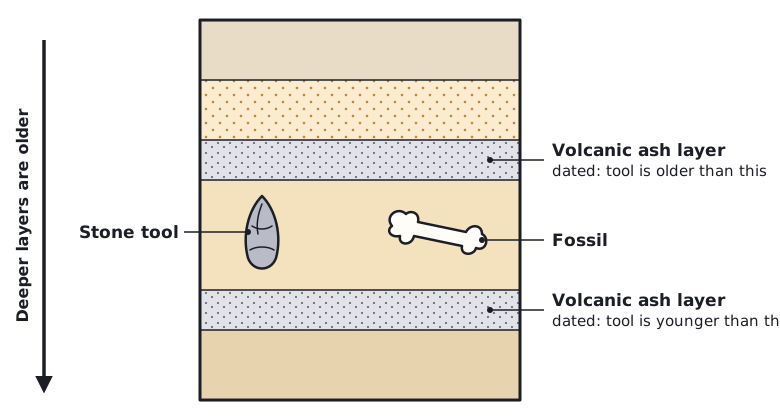
Cross-section of rock layers with a stone tool and a fossil in one layer, between an upper and a lower volcanic ash layer that can be dated; an arrow shows deeper layers are older. (opens full size in a new tab)
The tool is dated from its environment: it must be younger than the ash below it and older than the ash above it.

Written and checked against the Edexcel GCSE Combined Science (1SC0) specification · Updated October 2026

Frequently asked questions

What fossil evidence is there for human evolution?

Fossils show a gradual change from ape-like ancestors to modern humans. Ardi, from 4.4 million years ago, walked upright but could climb trees. Lucy, from 3.2 million years ago, walked upright with more human-like feet. Fossils from 1.6 million years ago show a larger brain and longer legs. Upright walking came first.

Why was the three-domain system introduced?

The three-domain system was introduced because improved genetic analysis showed that the prokaryotes are not all closely related. Comparing genetic material revealed differences that observing structure could not. So the prokaryotes were split into two domains, Archaea and Bacteria, with all organisms that have a nucleus in a third domain, Eukarya.

What do stone tools tell us about human evolution?

Stone tools show that early humans became more skilful over time. The oldest tools are very simple, with a few chips knocked off to make a sharp edge, while later tools are more carefully shaped and specialised for different jobs. This suggests greater skill and intelligence, which fits with fossil evidence of larger brains.

All 4 questions on Evidence for evolution and classification