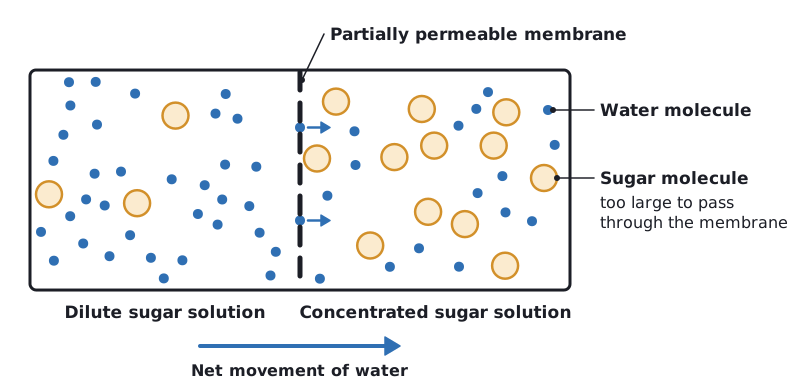
Osmosis is the diffusion of water from a dilute solution to a more concentrated solution through a partially permeable membrane. The membrane lets small molecules such as water through, but not larger molecules. Osmosis is a passive process, so it does not need energy from respiration. It only describes the movement of water, not of other particles.
Osmosis is the diffusion of water from a dilute solution to a more concentrated solution through a partially permeable membrane. A partially permeable membrane lets small molecules such as water through, but not larger molecules.
Osmosis is a passive process. It does not need energy from respiration.
Osmosis is only about water. Do not write that 'particles' move by osmosis, and do not forget the partially permeable membrane.
Written and checked against the Edexcel GCSE Combined Science (1SC0) specification · Updated October 2026
Frequently asked questions
How does osmosis differ from diffusion?
Osmosis is the diffusion of water only, through a partially permeable membrane, from a dilute solution to a more concentrated solution. Diffusion is the net movement of any particles, such as oxygen or carbon dioxide, from a higher to a lower concentration. Both are passive processes, so neither needs energy from respiration.
Why does osmosis not require energy?
Osmosis does not require energy because it is a passive process. Water diffuses from a dilute solution to a more concentrated solution through a partially permeable membrane, so no energy from respiration is needed. Active transport is different: it moves substances against a concentration gradient, so it does need energy from respiration.
Why is active transport important in root hair cells?
Active transport lets root hair cells take in mineral ions from the soil even when the concentration of ions is higher inside the cell than in the soil. This movement is against the concentration gradient, so diffusion cannot do it. Active transport uses energy from respiration to move the ions into the cell.

 (opens full size in a new tab)