
Root hair cellsSpec 6.7
In short
Root hair cells take in water and mineral ions from the soil. The long, thin root hair gives a large surface area, and a thin cell wall gives a short distance to cross. Water enters by osmosis, while mineral ions such as nitrate ions are taken in by active transport, using energy released by many mitochondria.
Root hair cells are found near the tips of roots. They take in water and mineral ions from the soil. Their structure is adapted for this job.
| Adaptation | How it helps |
|---|---|
| A long, thin projection (the root hair) | Gives a large surface area for absorbing water and mineral ions |
| A thin cell wall | A short distance for water and mineral ions to cross |
| Many mitochondria | Release energy by respiration for the active transport of mineral ions into the cell |
| Cell sap more concentrated than the soil water | Water moves into the cell by osmosis |
Mineral ions, such as nitrate ions, are usually at a lower concentration in the soil water than inside the cell. They are taken in by active transport, which needs energy from respiration.
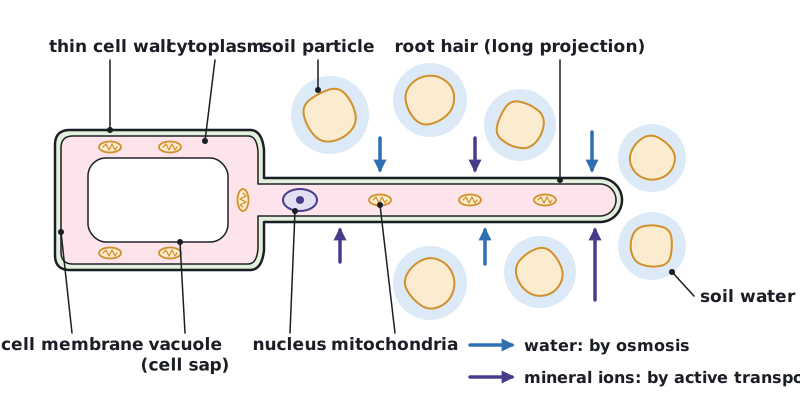 (opens full size in a new tab)
For an 'explain' question, link each adaptation to a function: 'the root hair gives a large surface area, so more water can be absorbed'.
Written and checked against the Edexcel GCSE Combined Science (1SC0) specification · Updated October 2026