
The main stages of genetic engineeringSpec 4.11
In short
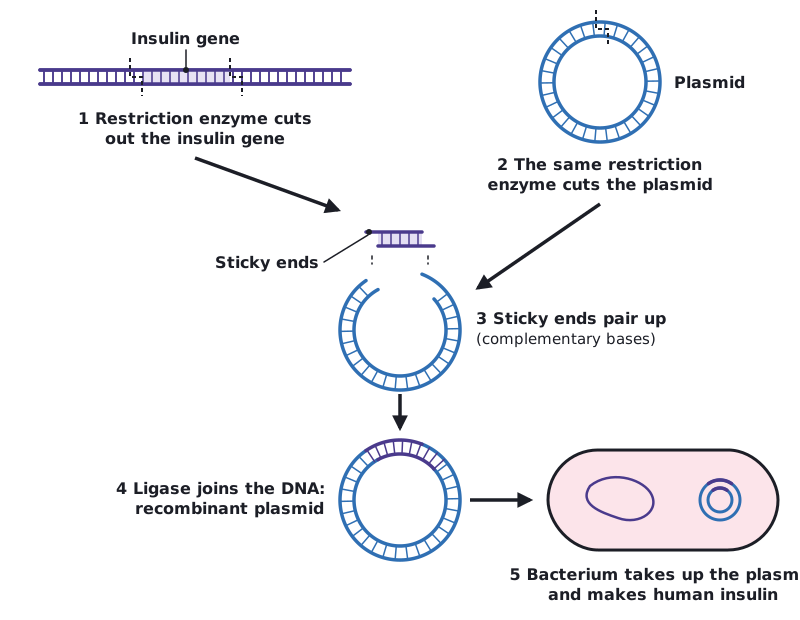
In genetic engineering, a restriction enzyme cuts the desired gene out of the donor DNA, leaving sticky ends. The same restriction enzyme cuts open a vector, such as a bacterial plasmid, giving matching sticky ends. The enzyme ligase joins the gene into the vector to make recombinant DNA, which carries the gene into the target organism's cells.
- The gene for the desired characteristic is cut out of the chromosome of the donor organism using a restriction enzyme. Each restriction enzyme cuts DNA at a specific sequence of bases.
- The cut leaves short, unpaired strands of DNA at each end. These are called sticky ends.
- The vector is cut open using the same restriction enzyme, so it has matching sticky ends. A vector is something used to carry the gene into the new cell, such as a bacterial plasmid or a virus.
- The gene and the vector are mixed. The sticky ends join by complementary base pairing, and the enzyme ligase joins the DNA strands together permanently. This makes recombinant DNA, for example a recombinant plasmid.
- The vector is used to insert the gene into the cells of the target organism (for example a bacterium, or a plant or animal at an early stage of development). The organism's cells now make the protein.
- Restriction enzyme
- An enzyme that cuts DNA at a specific base sequence.
- Sticky ends
- Short, unpaired strands of DNA left at the ends of a cut, which can join with complementary sticky ends.
- Ligase
- An enzyme that joins pieces of DNA together.
- Vector
- A carrier, such as a plasmid or virus, used to insert a gene into another organism's cells.
Use the same enzyme to cut both the gene and the vector. That gives matching sticky ends. Ligase then does the joining.
 (opens full size in a new tab)
Quick check
What is genetic engineering?
Show answer
Modifying the genome of an organism to introduce desirable characteristics.
What does a GM organism contain that a normal organism does not?
Show answer
A gene transferred from another organism.
Give one example of a desirable characteristic introduced by genetic engineering.
Show answer
For example, bacteria making human insulin, or crop plants resistant to insects.
Written and checked against the Edexcel GCSE Combined Science (1SC0) specification · Updated October 2026