
Book a tutor

Interactions between limiting factors

Plant structures and their functions · Photosynthesis and limiting factors · note 4 of 6

Spec 6.4
Higher tier (what this means)Higher tier: only on the Higher tier papers. Foundation students can skip it. What the labels mean
Download all Photosynthesis and limiting factors notes (PDF)Download all notes (PDF)7 pages

Interactions between limiting factorsSpec 6.4

In short

Temperature, light intensity and carbon dioxide concentration all act at the same time, and the rate of photosynthesis is limited by whichever factor is in shortest supply. Where a graph levels off, the factor on the x-axis is no longer limiting. A line with a higher plateau has more of another factor, such as carbon dioxide concentration.

Temperature, light intensity and carbon dioxide concentration all act at the same time. At any moment, the rate of photosynthesis is limited by whichever factor is in shortest supply.

To explain a graph, find where the line levels off. At that point the factor on the x-axis is no longer limiting. Something else is, and it will be a factor that is not being increased.

  • If a graph for light intensity has two lines, the line with a higher plateau has more of the other factor, for example a higher carbon dioxide concentration or a better temperature.
  • The two lines are the same at low light intensity because light is the limiting factor for both.
  • At the plateau, the lower line is limited by the factor that differs between the two conditions.
  • If increasing one factor makes no difference to the rate, a different factor is limiting.
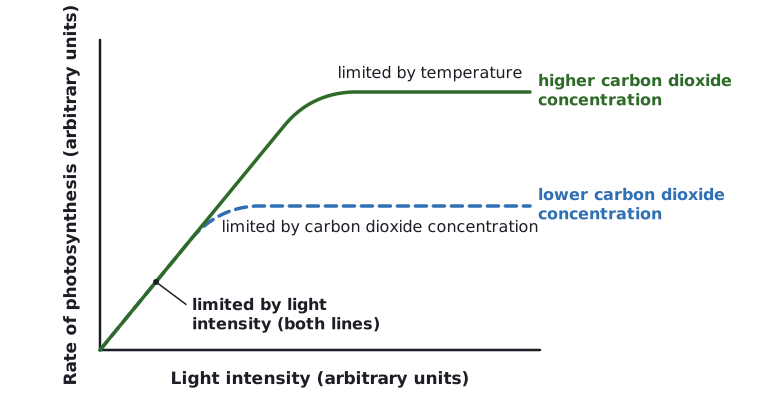
Graph of rate of photosynthesis against light intensity with two curves that overlap at low light (limited by light intensity); the lower carbon dioxide curve levels off lower, limited by carbon dioxide concentration, and the higher carbon dioxide curve levels off higher, limited by temperature. (opens full size in a new tab)
Where each line levels off, light is no longer limiting. The factor in shortest supply sets the plateau.
Exam tip:

Name the factor in your answer. 'Another factor is limiting' will not get the mark. Say which one and give the reason, for example 'carbon dioxide concentration is limiting because the rate rises when it is increased'.

Written and checked against the Edexcel GCSE Combined Science (1SC0) specification · Updated October 2026

Frequently asked questions

How does light intensity affect the rate of photosynthesis?

As light intensity increases, the rate of photosynthesis increases, then levels off. Light provides the energy for the reaction, so at low light intensity the amount of light limits the rate. At high light intensity the line goes flat because another factor, such as carbon dioxide concentration or temperature, is now limiting.

How does temperature affect the rate of photosynthesis?

The rate of photosynthesis increases with temperature up to an optimum, then falls sharply. Photosynthesis is controlled by enzymes, and a higher temperature gives more collisions between enzymes and substrates. Above the optimum the enzymes are denatured because their active site changes shape, so the rate falls. Enzymes are denatured, not killed.

What are the limiting factors of photosynthesis?

The limiting factors of photosynthesis are temperature, light intensity and carbon dioxide concentration. A limiting factor is in short supply, so it stops the rate from going any faster. On a graph, the rate rises while the factor on the x-axis is limiting, and the line levels off when something else becomes limiting.

All 5 questions on Photosynthesis and limiting factors