
Eukaryotes and prokaryotesSpec 4.1.1.1
In short
Eukaryotic cells, such as plant and animal cells, have a cell membrane, cytoplasm and genetic material enclosed in a nucleus. Prokaryotic cells, such as bacteria, are much smaller. Their genetic material is not enclosed in a nucleus: it is a single DNA loop, and there may be one or more small rings of DNA called plasmids.
Plant and animal cells are eukaryotic cells. They have a cell membrane, cytoplasm and genetic material enclosed in a nucleus.
Bacterial cells are prokaryotic cells. They are much smaller in comparison. They have cytoplasm and a cell membrane surrounded by a cell wall. The genetic material is not enclosed in a nucleus. It is a single DNA loop, and there may be one or more small rings of DNA called plasmids.
| Eukaryotic cell (plant, animal) | Prokaryotic cell (bacterium) | |
|---|---|---|
| Size | Larger | Much smaller |
| Genetic material | Enclosed in a nucleus | Single DNA loop, not enclosed in a nucleus |
| Plasmids | No | One or more may be present |
| Cell membrane and cytoplasm | Yes | Yes |
| Cell wall | Plant and algal cells (made of cellulose); not animal cells | Yes |
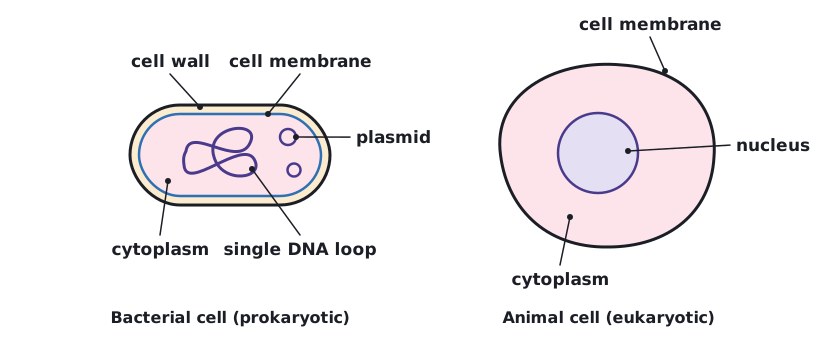 (opens full size in a new tab)
Bacteria do have genetic material. Write that it is not enclosed in a nucleus, never that bacteria have no DNA.
Scale and size of cells
You need to understand the scale and size of cells and be able to make order of magnitude calculations. An order of magnitude is a power of ten. A cell that is 100 times wider than another is two orders of magnitude bigger, because 100 = 10².
| Prefix | Symbol | Standard form (compared with 1 m) | Example |
|---|---|---|---|
| centi | c | × 10⁻² | 1 cm = 0.01 m |
| milli | m | × 10⁻³ | 1 mm = 0.001 m |
| micro | µ | × 10⁻⁶ | 1 µm = 0.000 001 m |
| nano | n | × 10⁻⁹ | 1 nm = 0.000 000 001 m |
To change units: 1 mm = 1000 µm and 1 µm = 1000 nm. Standard form is a number between 1 and 10 multiplied by a power of ten, for example 0.000 004 m = 4 × 10⁻⁶ m.
Order of magnitude
A plant cell is 100 µm long. A bacterium is 1 µm long. How many orders of magnitude longer is the plant cell?
- Divide the larger length by the smaller: 100 ÷ 1 = 100.
- Write the answer as a power of ten: 100 = 10².
Answer: The plant cell is 10² (100) times longer, which is two orders of magnitude.
Standard form
A cell is 0.000 025 m wide. Write this in standard form, then in µm.
- Move the decimal point to give a number between 1 and 10: 2.5.
- Count the places moved: 5. Because the number is small, the power is negative: 2.5 × 10⁻⁵ m.
- To convert to µm, multiply metres by 1 000 000: 0.000 025 × 1 000 000 = 25.
Answer: 2.5 × 10⁻⁵ m, which is 25 µm.
A negative power of ten means a number smaller than 1. Check the sign of your power by asking whether the number you started with was big or small.
Written and checked against the AQA GCSE Biology (8461) specification · Updated October 2026