Malaria is a disease caused by a protist, whose life cycle includes the mosquito. It causes recurrent episodes of fever and can be fatal. The mosquito is a vector: it carries the protist from one person to another when it feeds on blood. Malaria is controlled by stopping mosquitos from breeding and by using mosquito nets to avoid bites.
The pathogens that cause malaria are protists. The malarial protist has a life cycle that includes the mosquito.
Malaria causes recurrent episodes of fever and can be fatal.
How malaria spreads
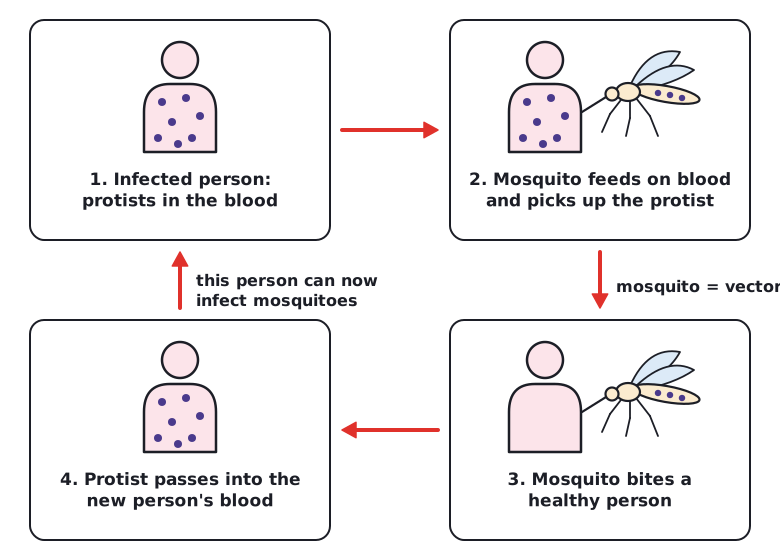
The mosquito is a vector: an organism that carries a pathogen from one host to another. A mosquito picks up the protist when it feeds on the blood of an infected person. It passes the protist on when it bites another person.
Controlling malaria
Prevent the vectors, the mosquitos, from breeding.
Use mosquito nets to avoid being bitten.
Vector
An organism that carries a pathogen from one host to another. For malaria the vector is the mosquito.
Common mistake:
The mosquito is not the pathogen. The pathogen is the protist, and the mosquito carries it between people.
Written and checked against the AQA GCSE Biology (8461) specification · Updated October 2026
Frequently asked questions
How do pathogens spread?
Pathogens spread by direct contact, by water or by air. HIV and gonorrhoea spread by sexual contact, and HIV also by the exchange of body fluids such as blood. Measles spreads in droplets from sneezes and coughs, and rose black spot by water or wind. Salmonella spreads in food, and malaria is carried by mosquitos.
How do white blood cells fight infection?
White blood cells fight infection in three ways. Some engulf and digest pathogens, which is called phagocytosis. Others produce antibodies, which target a particular pathogen and help to destroy it, and antitoxins, which neutralise the toxins released by pathogens. This is the immune system, which acts when a pathogen gets past the non-specific defences.
How do vaccines work?
Vaccines work by introducing small quantities of dead or inactive pathogen into the body, which stimulates white blood cells to produce antibodies. If the same pathogen enters the body later, the white blood cells respond quickly to make the correct antibodies, so the pathogen is destroyed before it causes illness. A vaccine does not contain antibodies itself.

 (opens full size in a new tab)