
Developments in classificationSpec 4.6.4
In short
The three-domain system divides organisms into Archaea, Bacteria and Eukaryota, based on evidence from chemical analysis. Archaea are primitive bacteria usually living in extreme environments, Bacteria are true bacteria, and Eukaryota include protists, fungi, plants and animals. New models of classification were proposed as better microscopes revealed internal structures and the understanding of biochemical processes progressed.
As evidence of internal structures became more developed due to improvements in microscopes, and the understanding of biochemical processes progressed, new models of classification were proposed.
Due to evidence available from chemical analysis, there is now a three-domain system developed by Carl Woese. In this system, organisms are divided into:
| Domain | Description |
|---|---|
| Archaea | Primitive bacteria, usually living in extreme environments |
| Bacteria | True bacteria |
| Eukaryota | Includes protists, fungi, plants and animals |
Evolutionary trees
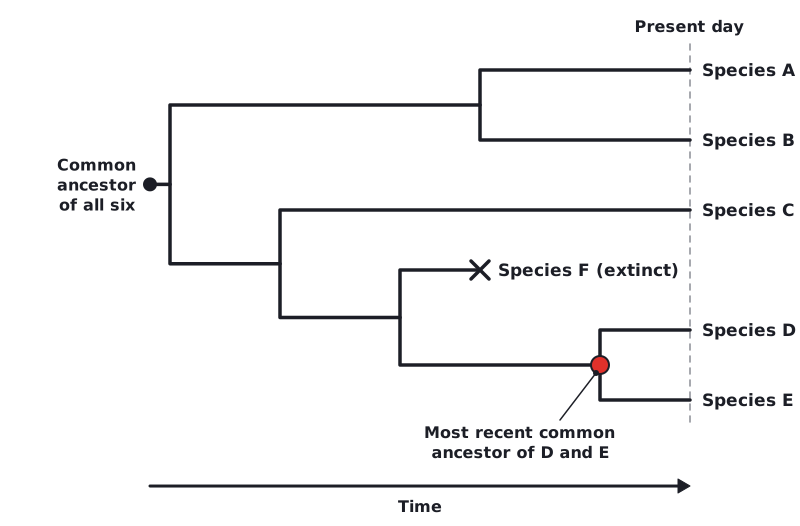
Evolutionary trees are a method used by scientists to show how they believe organisms are related. They use current classification data for living organisms and fossil data for extinct organisms. The more recently two branches split from a common ancestor, the more closely related the organisms are.
 (opens full size in a new tab)
To read a tree, find the point where two branches split. The nearer that point is to the present, the more closely related the two species are.
Quick check
List the Linnaean groups from largest to smallest.
Show answer
Kingdom, phylum, class, order, family, genus, species.
Which two groups make up a binomial name?
Show answer
Genus and species.
Name the three domains in Woese's system.
Show answer
Archaea, bacteria and eukaryota.
What data are used to build evolutionary trees?
Show answer
Current classification data for living organisms and fossil data for extinct organisms.
Written and checked against the AQA GCSE Biology (8461) specification · Updated October 2026