Coronary heart disease is a non-communicable disease in which layers of fatty material build up inside the coronary arteries, narrowing them. This reduces blood flow through the coronary arteries, so the heart muscle gets less oxygen. Stents are used to keep the arteries open, and statins reduce blood cholesterol, slowing down the rate of fatty material deposit.
Coronary heart disease (CHD) is a non-communicable disease: it is not caused by a pathogen and cannot be passed from person to person.
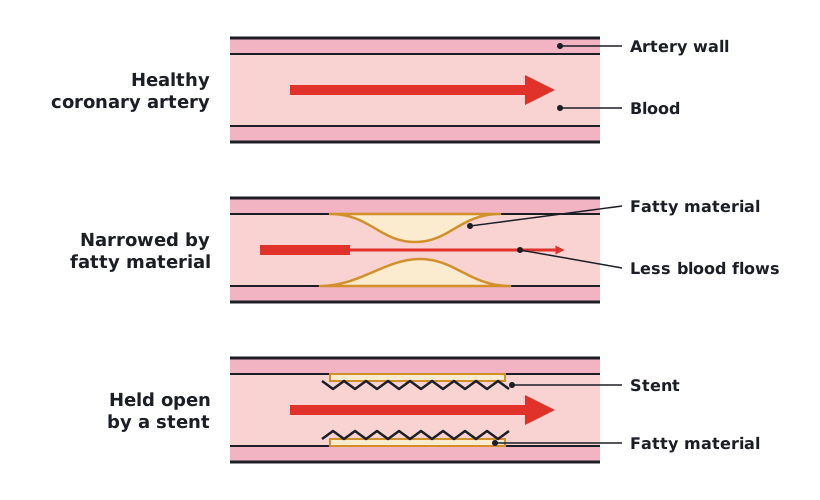
In CHD, layers of fatty material build up inside the coronary arteries, narrowing them. This reduces the flow of blood through the coronary arteries, resulting in a lack of oxygen for the heart muscle.
Stents are used to keep the coronary arteries open.
Statins are widely used to reduce blood cholesterol levels, which slows down the rate of fatty material deposit.
Fatty material builds up inside a coronary artery.
The artery narrows, so less blood flows through it.
The heart muscle receives less oxygen.
Common mistake:
CHD affects the coronary arteries, which supply the heart itself. It is not a problem with the blood vessels going to the lungs or the brain.
Written and checked against the AQA GCSE Biology (8461) specification · Updated October 2026
Frequently asked questions
Why do enzymes denature at high temperatures?
At high temperatures the shape of the enzyme's active site changes, so the substrate no longer fits and the reaction cannot be catalysed. The enzyme is denatured, and this cannot be changed back. Below the optimum, the rate rises with temperature because particles move faster and collide more often. Enzymes are not killed, because they are not alive.
How are alveoli adapted for gas exchange?
Millions of alveoli give a very large surface area for diffusion. Their walls are one cell thick, so the diffusion distance is short. A network of capillaries carries oxygen away and brings carbon dioxide, and constant ventilation brings fresh air. Both keep a steep concentration gradient, so oxygen diffuses into the blood and carbon dioxide diffuses out quickly.
Why is the left ventricle thicker than the right?
The left ventricle has a thicker muscular wall than the right because it pumps blood all the way around the body at a higher pressure. The right ventricle only pumps blood to the lungs. Both are part of the double circulatory system, in which blood passes through the heart twice on each complete circuit.

 (opens full size in a new tab)