
Book a tutor

Trophic levels

Ecology · Trophic levels in an ecosystem · note 1 of 3

Spec 4.7.4.1
Triple only (what this means)Triple only: only in Triple Biology. Combined Science students can skip it. What the labels mean
Download all Trophic levels in an ecosystem notes (PDF)Download all notes (PDF)4 pages

Trophic levelsSpec 4.7.4.1

In short

Trophic levels are the feeding levels of a food chain, numbered from level 1. Level 1 is producers (plants and algae), level 2 is herbivores (primary consumers), and levels 3 and 4 are carnivores (secondary and tertiary consumers). Apex predators are carnivores with no predators. Decomposers secrete enzymes onto dead matter, then soluble food molecules diffuse in.

Trophic levels can be represented by numbers, starting at level 1 with plants and algae. Further trophic levels are numbered subsequently according to how far the organism is along the food chain.

Trophic levelOrganismsName
Level 1Plants and algae make their own foodProducers
Level 2Herbivores eat plants and algaePrimary consumers
Level 3Carnivores that eat herbivoresSecondary consumers
Level 4Carnivores that eat other carnivoresTertiary consumers

Apex predators are carnivores with no predators.

Decomposers

Decomposers break down dead plant and animal matter by secreting enzymes into the environment. Small soluble food molecules then diffuse into the microorganism.
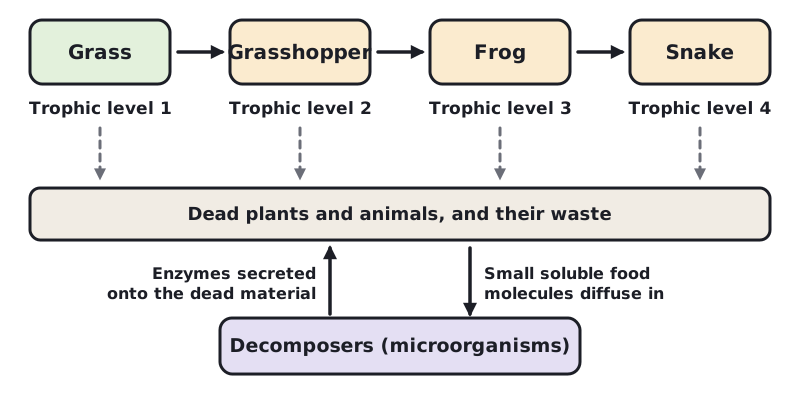
Food chain of grass, grasshopper, frog and snake labelled trophic levels 1 to 4, with dashed arrows from each to dead plants and animals and their waste; below, decomposers (microorganisms) secrete enzymes onto the dead material and small soluble food molecules diffuse into them. (opens full size in a new tab)
Every trophic level ends up as dead material or waste. Decomposers secrete enzymes onto it, then the small soluble molecules diffuse in.
Exam tip:

Decomposers secrete enzymes outside their bodies, onto the dead material. Small soluble food molecules then diffuse in. Decomposers do not take in the dead material and then digest it.

Written and checked against the AQA GCSE Biology (8461) specification · Updated October 2026

Frequently asked questions

Why is energy lost between trophic levels?

Energy is lost between trophic levels because biomass is lost: only about 10% of the biomass passes to the next level. Some ingested material is egested as faeces. Some absorbed material is lost as waste, such as carbon dioxide and water from respiration and water and urea in urine. Large amounts of glucose are also used in respiration.

What is a pyramid of biomass?

A pyramid of biomass is a diagram that shows the relative amount of biomass at each trophic level of a food chain, with the producers at the bottom. Each bar is narrower than the one below, because biomass decreases at each higher trophic level. The length of each bar is drawn to scale, proportional to the biomass of that level.

Why are food chains short?

Food chains are short because so much biomass is lost at each step. Only about 10% of the biomass at one trophic level is transferred to the level above, as the rest is egested, lost as waste or used in respiration. So less biomass is available at each higher level, and fewer organisms can be supported.

All 4 questions on Trophic levels in an ecosystem