
Exchange surfacesSpec 4.1.3.1
In short
An exchange surface is a surface specialised for moving materials into and out of an organism, such as the small intestine, lungs, gills, roots and leaves. Its effectiveness is increased by a large surface area and a thin membrane that gives a short diffusion path. In animals, an efficient blood supply and, for gas exchange, ventilation also help.
In multicellular organisms, surfaces and organ systems are specialised for exchanging materials. This is to allow sufficient molecules to be transported into and out of cells for the organism's needs. The effectiveness of an exchange surface is increased by:
- having a large surface area
- a membrane that is thin, to provide a short diffusion path
- (in animals) having an efficient blood supply
- (in animals, for gaseous exchange) being ventilated.
| Exchange surface | Substances exchanged | Adaptations |
|---|---|---|
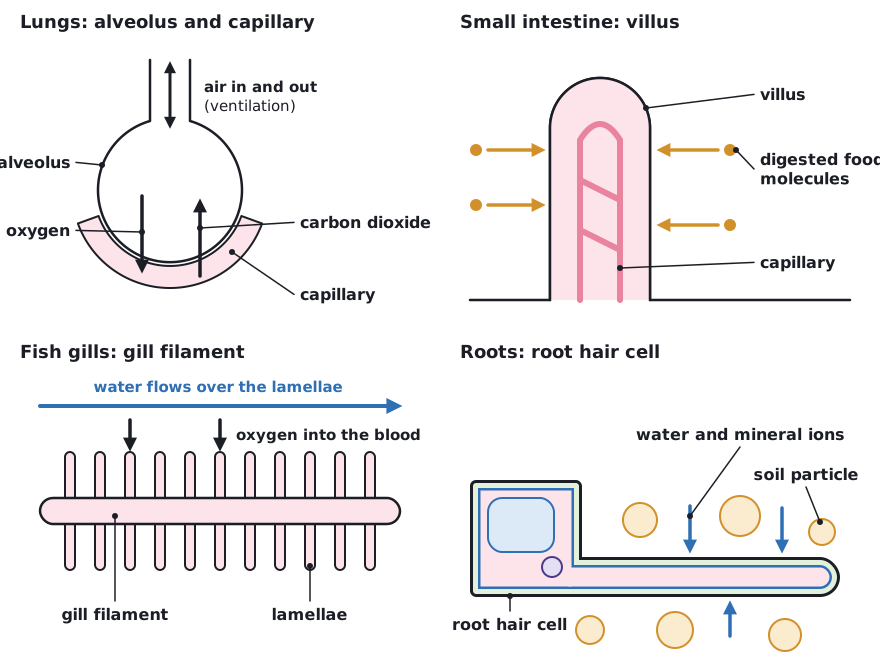
| Small intestine (mammals) | Digested food molecules into the blood | Villi give a large surface area; thin lining gives a short diffusion path; good blood supply carries absorbed molecules away |
| Lungs (mammals) | Oxygen into the blood, carbon dioxide out | Many alveoli give a large surface area; thin walls; good blood supply; ventilated by breathing |
| Gills (fish) | Oxygen from the water into the blood, carbon dioxide out | Many gill filaments covered in folds called lamellae give a large surface area; thin; good blood supply; ventilated as water flows over them |
| Roots (plants) | Water and mineral ions into the plant | Root hair cells give a large surface area; thin cell walls give a short diffusion path |
| Leaves (plants) | Carbon dioxide into the leaf, oxygen and water vapour out | Flat shape and air spaces inside give a large surface area; thin leaf gives a short diffusion path; stomata let gases in and out |
 (opens full size in a new tab)
A maintained concentration gradient comes from the blood supply (in animals) and from ventilation. Say that both keep the concentration gradient steep so diffusion stays fast.
Written and checked against the AQA GCSE Biology (8461) specification · Updated October 2026