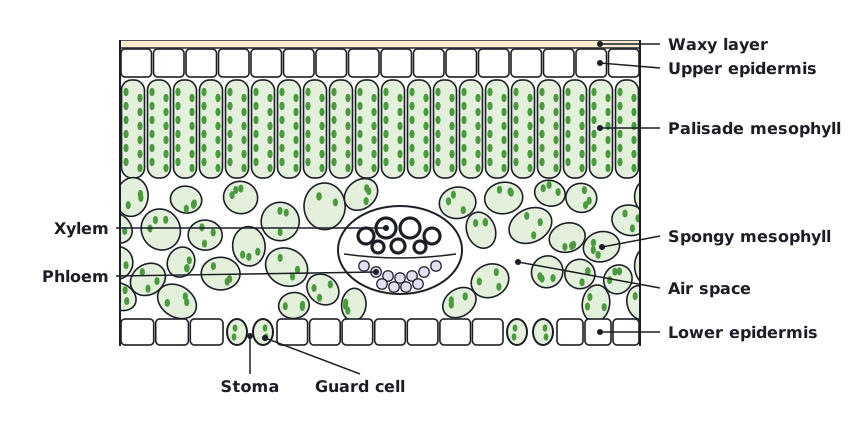
The leaf is a plant organ made of several tissues that work together. The epidermis covers it, with stomata in the lower epidermis. Most photosynthesis happens in the palisade mesophyll, and the spongy mesophyll has air spaces for gases. Xylem and phloem in the veins bring water in and take sugars away, and guard cells control the stomata.
The leaf is a plant organ. It is made up of several tissues that work together. Knowledge is limited to the epidermis, palisade and spongy mesophyll, xylem and phloem, and guard cells surrounding stomata.
The epidermis covers the leaf. The lower epidermis contains stomata.
Palisade mesophyll lies below the upper epidermis. It is where most photosynthesis happens.
Spongy mesophyll lies below the palisade layer. Its air spaces let gases move around.
Xylem and phloem in the leaf veins bring water to the leaf and take sugars away.
Guard cells surround each stomatal pore and control its opening.
When you draw a leaf section from a microscope, draw what you see, not what you expect. Use clear lines, draw in pencil, do not shade, and label the tissues.
Written and checked against the AQA GCSE Biology (8461) specification · Updated October 2026
Frequently asked questions
How does water move from roots to leaves?
Water enters root hair cells by osmosis, then moves up through the xylem to the leaves in a continuous flow called the transpiration stream. In the leaf, water evaporates from the surface of the mesophyll cells into the air spaces, and water vapour diffuses out through the stomata. This loss of water vapour from the leaves is transpiration.
How does light intensity affect the rate of transpiration?
Increasing light intensity increases the rate of transpiration, because stomata open wider in the light, so more water vapour can diffuse out of the leaf. In darkness the rate falls. Higher temperature and more air movement also increase the rate of transpiration, while higher humidity decreases it. A potometer can be used to measure these effects.
What is the difference between xylem and phloem?
Xylem transports water and mineral ions from the roots to the stems and leaves in the transpiration stream, and is made of hollow tubes strengthened by lignin. Phloem transports dissolved sugars from the leaves to the rest of the plant by translocation, and is made of tubes of elongated cells with pores in the end walls.

 (opens full size in a new tab)