
DiffusionSpec 4.1.3.1
In short
Diffusion is the spreading out of particles of a gas or of a substance in solution, resulting in a net movement from an area of higher concentration to an area of lower concentration. Oxygen, carbon dioxide and urea move by diffusion. The rate is faster with a bigger concentration gradient, a higher temperature and a larger membrane surface area.
Substances may move into and out of cells across the cell membranes via diffusion.
- Diffusion
- The spreading out of the particles of any substance in solution, or particles of a gas, resulting in a net movement from an area of higher concentration to an area of lower concentration.
Some of the substances transported in and out of cells by diffusion are oxygen and carbon dioxide in gas exchange, and the waste product urea from cells into the blood plasma for excretion in the kidney.
Factors affecting the rate of diffusion
| Factor | Effect on the rate of diffusion |
|---|---|
| Difference in concentrations (concentration gradient) | A bigger difference means a faster rate, because more particles move down the gradient in the same time |
| Temperature | A higher temperature means a faster rate, because the particles have more energy and move faster |
| Surface area of the membrane | A larger surface area means a faster rate, because more particles can cross at once |
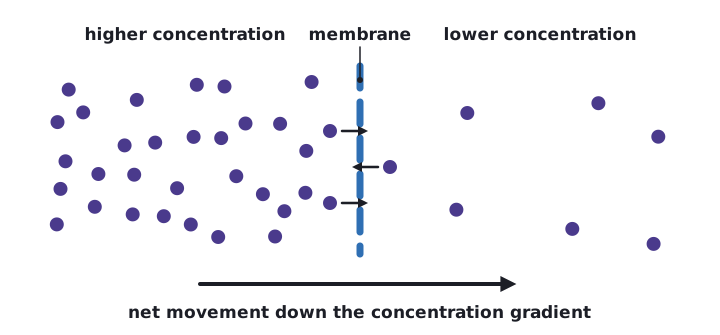 (opens full size in a new tab)
Always say 'net movement' and 'down a concentration gradient'. Particles move in both directions, but more move from the high concentration side.
Written and checked against the AQA GCSE Biology (8461) specification · Updated October 2026