
Roots, xylem and phloemSpec 4.2.3.2
In short
The roots, stem and leaves form a plant organ system for transport. Root hair cells absorb water by osmosis and mineral ions by active transport, helped by a large surface area and many mitochondria. Xylem, made of hollow tubes strengthened by lignin, carries water and mineral ions up the plant. Phloem moves dissolved sugars by translocation.
The roots, stem and leaves form a plant organ system for transport of substances around the plant.
Root hair cells
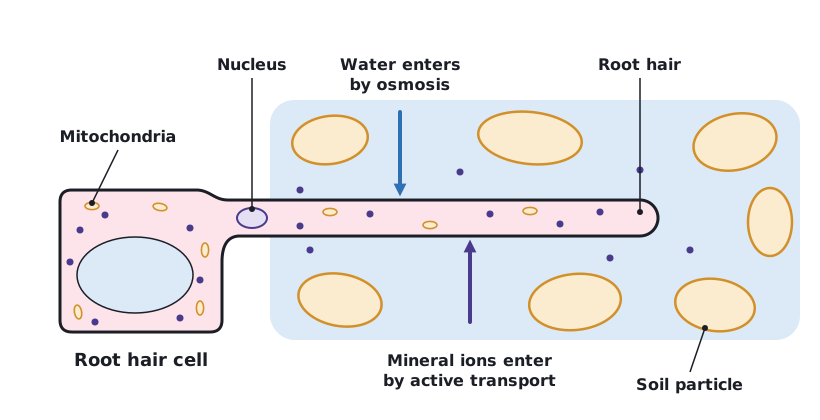
Root hair cells are adapted for the efficient uptake of water by osmosis and mineral ions by active transport.
- The long root hair gives a large surface area for taking in water and mineral ions.
- Mineral ions are usually at a lower concentration in the soil than in the cell, so they move into the cell against the concentration gradient by active transport. This needs energy from respiration, so root hair cells contain many mitochondria.
- Water moves in by osmosis.
Xylem
Xylem tissue transports water and mineral ions from the roots to the stems and leaves. It is composed of hollow tubes strengthened by lignin. It is adapted for the transport of water in the transpiration stream.
Phloem
Phloem tissue transports dissolved sugars from the leaves to the rest of the plant for immediate use or storage. The movement of food molecules through phloem tissue is called translocation.
Phloem is composed of tubes of elongated cells. Cell sap can move from one phloem cell to the next through pores in the end walls.
| Xylem | Phloem | |
|---|---|---|
| Transports | Water and mineral ions | Dissolved sugars |
| Direction | From the roots to the stems and leaves | From the leaves to the rest of the plant |
| Structure | Hollow tubes strengthened by lignin | Tubes of elongated cells with pores in the end walls |
| Process | Transpiration stream | Translocation |
The detailed structure of phloem tissue and the mechanism of transport are not required, so just learn what is written above.
 (opens full size in a new tab)
Written and checked against the AQA GCSE Biology (8461) specification · Updated October 2026