Book a tutor

Accommodation

Homeostasis and response · The human nervous system · note 6 of 8

Spec 4.5.2.3
Triple only (what this means)Triple only: only in Triple Biology. Combined Science students can skip it. What the labels mean
Download all The human nervous system notes (PDF)Download all notes (PDF)9 pages

AccommodationSpec 4.5.2.3

In short

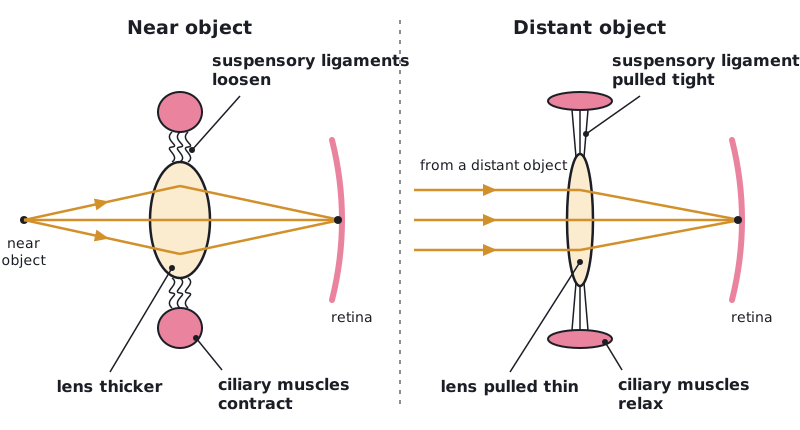
Accommodation is the process of changing the shape of the lens to focus on near or distant objects. For a near object the ciliary muscles contract, the suspensory ligaments loosen and the lens becomes thicker, so it refracts light strongly. For a distant object the ciliary muscles relax, the ligaments are pulled tight and the lens is pulled thin.

Accommodation
The process of changing the shape of the lens to focus on near or distant objects.
Focusing on near and distant objects
Near objectDistant object
Ciliary musclesContractRelax
Suspensory ligamentsLoosenPulled tight
Lens shapeThickerPulled thin
Refraction of light raysStronglyOnly slightly
Two lens diagrams: for a near object the ciliary muscles contract, the suspensory ligaments loosen and the lens is thicker; for a distant object the ciliary muscles relax, the suspensory ligaments are pulled tight and the lens is pulled thin. In both, light rays focus on the retina. (opens full size in a new tab)
Accommodation. Near object: muscles contract, ligaments loosen, lens thicker. Distant object: muscles relax, ligaments tight, lens thin.
Common mistake:

For a near object the ciliary muscles contract and the ligaments go slack. Many students reverse this. Remember: contracted muscle, loose ligaments, fat lens.

Written and checked against the AQA GCSE Biology (8461) specification · Updated October 2026

Frequently asked questions

What is a reflex arc?

A reflex arc is the pathway of an automatic, rapid response. A receptor detects a stimulus, a sensory neurone carries the impulse to the CNS, a relay neurone passes it on, and a motor neurone carries it to an effector, a muscle or gland, which responds. It does not involve the conscious part of the brain.

Why are reflexes faster than normal responses?

Reflexes are faster because the reflex arc does not go through the conscious part of the brain. The impulse passes from the sensory neurone, through a relay neurone, to the motor neurone, so the response happens before you are aware of it. This protects the body, for example pulling your hand away from a hot object.

How does a nerve impulse cross the synapse?

A nerve impulse crosses a synapse using chemicals. A synapse is a gap between two neurones. When an impulse reaches the end of one neurone, chemicals diffuse across the gap and start an impulse in the next neurone. This is how an impulse passes from a sensory neurone to a relay neurone, and on to a motor neurone.

All 5 questions on The human nervous system