
DNA structureSpec 4.6.1.5
In short
DNA is a polymer made from four different nucleotides. Each nucleotide is a common sugar and phosphate group with one of four bases, A, C, G or T, attached to the sugar. A sequence of three bases codes for one amino acid, and the order of bases controls the order of amino acids in a protein.
DNA is a polymer made from four different nucleotides. The DNA polymer is made up of repeating nucleotide units.
Each nucleotide consists of a common sugar and phosphate group, with one of four different bases attached to the sugar. The long strands of DNA have alternating sugar and phosphate sections, and one of the four bases is attached to each sugar.
DNA contains four bases: A, C, G and T. A sequence of three bases is the code for a particular amino acid. The order of bases controls the order in which amino acids are assembled to produce a particular protein.
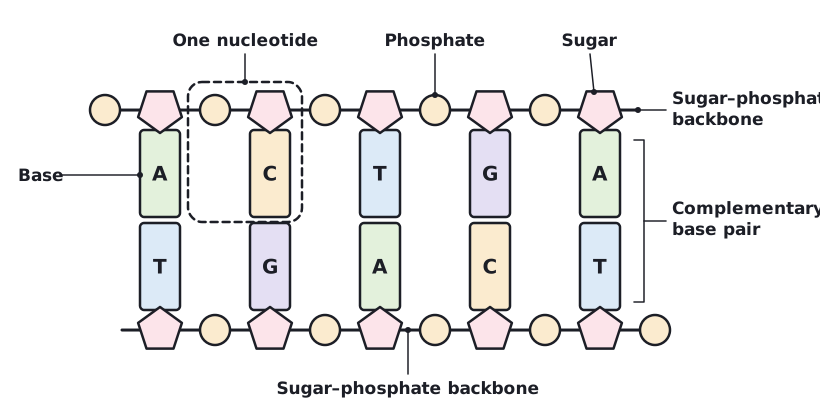 (opens full size in a new tab)
You must be able to interpret a diagram of DNA structure, but you will not be asked to draw it from memory.
Higher tier (what this means)
Higher tier: only on the Higher tier papers. Foundation students can skip it. What the labels meanComplementary base pairing
Higher tier (what this means)
Higher tier: only on the Higher tier papers. Foundation students can skip it. What the labels meanIn the complementary strands, C is always linked to G on the opposite strand and T is always linked to A.
Higher tier (what this means)
Higher tier: only on the Higher tier papers. Foundation students can skip it. What the labels meanProtein synthesis
Higher tier (what this means)
Higher tier: only on the Higher tier papers. Foundation students can skip it. What the labels mean- Proteins are made on ribosomes, according to a template.
- Carrier molecules bring specific amino acids to add to the growing protein chain in the correct order.
- When the protein chain is complete, it folds up to form a unique shape.
- This unique shape lets the protein do its job, for example as an enzyme, a hormone, or a structure in the body such as collagen.
Higher tier (what this means)
Higher tier: only on the Higher tier papers. Foundation students can skip it. What the labels meanYou are not expected to know or understand the structure of mRNA or tRNA, or the detailed structure of amino acids or proteins.
Higher tier (what this means)
Higher tier: only on the Higher tier papers. Foundation students can skip it. What the labels meanMutations and their effects
Higher tier (what this means)
Higher tier: only on the Higher tier papers. Foundation students can skip it. What the labels meanA change in the structure of DNA changes the order of bases. This can change the order of amino acids, so a different protein can be made. Mutations occur continuously. Most do not alter the protein, or only alter it slightly, so its appearance or function is not changed.
Higher tier (what this means)
Higher tier: only on the Higher tier papers. Foundation students can skip it. What the labels meanA few mutations code for an altered protein with a different shape. An enzyme may no longer fit the substrate binding site, or a structural protein may lose its strength.
Higher tier (what this means)
Higher tier: only on the Higher tier papers. Foundation students can skip it. What the labels meanNon-coding DNA
Higher tier (what this means)
Higher tier: only on the Higher tier papers. Foundation students can skip it. What the labels meanNot all parts of DNA code for proteins. Non-coding parts of DNA can switch genes on and off, so variations in these areas may affect how genes are expressed.
Higher tier (what this means)
Higher tier: only on the Higher tier papers. Foundation students can skip it. What the labels meanGenetic variants may influence the phenotype in two ways: in coding DNA by altering the activity of a protein, and in non-coding DNA by altering how genes are expressed.
Higher tier (what this means)
Higher tier: only on the Higher tier papers. Foundation students can skip it. What the labels meanFor 'explain how a mutation changes a protein', link the chain: base sequence changes, amino acid order changes, protein folds into a different shape, so it can no longer do its job (for example an enzyme's active site no longer fits its substrate).
Written and checked against the AQA GCSE Biology (8461) specification · Updated October 2026