
Book a tutor

How four hormones control the cycle

Animal coordination, control and homeostasis · The menstrual cycle and fertility control · note 2 of 5

Spec 7.5
Higher tier (what this means)Higher tier: only on the Higher tier papers. Foundation students can skip it. What the labels mean
Download all The menstrual cycle and fertility control notes (PDF)Download all notes (PDF)5 pages

How four hormones control the cycleSpec 7.5

In short

The menstrual cycle is controlled by four hormones: FSH and LH from the pituitary gland, and oestrogen and progesterone from the ovaries. FSH makes an egg mature and stimulates oestrogen production. High oestrogen inhibits FSH and stimulates the release of LH, which causes ovulation. Progesterone maintains the uterus lining and inhibits FSH and LH.

Four hormones interact to control the cycle. FSH and LH are released by the pituitary gland. Oestrogen and progesterone are made by the ovaries.

Hormones of the menstrual cycle
HormoneMade inWhat it does
FSHPituitary glandCauses an egg to mature in an ovary. Stimulates the ovaries to produce oestrogen
OestrogenOvariesRepairs and builds up the uterus lining. Inhibits FSH. Stimulates the release of LH
LHPituitary glandCauses ovulation
ProgesteroneOvariesMaintains the uterus lining. Inhibits FSH and LH
  1. FSH makes an egg mature and stimulates the ovaries to make oestrogen.
  2. Oestrogen repairs the uterus lining. When oestrogen is high it inhibits FSH and stimulates the release of LH.
  3. LH causes ovulation, around day 14.
  4. After ovulation the ovary produces progesterone, which maintains the lining and inhibits FSH and LH, so no more eggs mature.
  5. If there is no pregnancy, progesterone falls. The lining is no longer maintained and breaks down. This is menstruation.
Exam tip:

Always say what each hormone does to the next one: stimulates or inhibits. Just writing ‘oestrogen affects LH’ will not score.
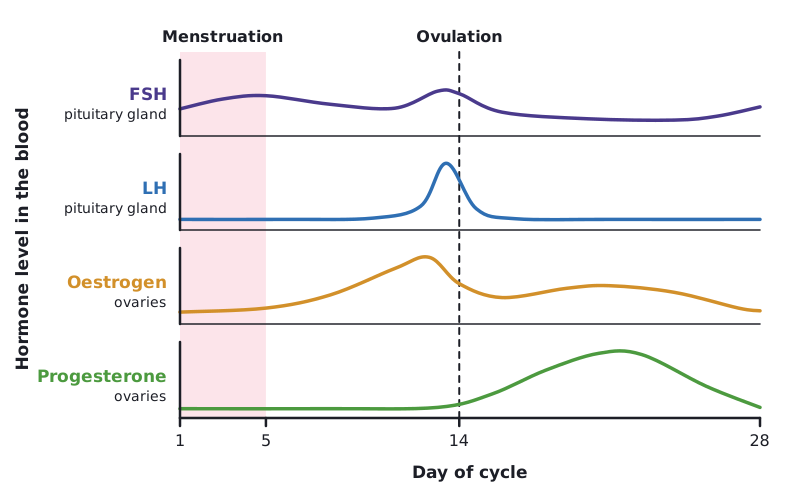
Four stacked graphs over a 28-day cycle: FSH peaks early and slightly before day 14, LH has a sharp peak just before ovulation at day 14, oestrogen rises to a peak before ovulation, and progesterone rises after ovulation, peaks around day 21 and falls before menstruation. (opens full size in a new tab)
Levels of FSH, LH, oestrogen and progesterone. The LH surge triggers ovulation around day 14.

Written and checked against the Edexcel GCSE Biology (1BI0) specification · Updated October 2026

Frequently asked questions

What happens during the menstrual cycle?

The menstrual cycle repeats about every 28 days. On days 1 to 5 the uterus lining breaks down and is lost in menstruation. From day 5 to 14 oestrogen repairs the lining and it thickens. An egg is released at ovulation around day 14, then progesterone maintains the lining until day 28, ready for a fertilised egg.

What does FSH do in the menstrual cycle?

Higher tier FSH, released by the pituitary gland, causes an egg to mature in an ovary and stimulates the ovaries to produce oestrogen. As oestrogen rises it inhibits FSH and stimulates the release of LH, which causes ovulation. After ovulation, progesterone inhibits FSH and LH, so no more eggs mature while the uterus lining is maintained.

How do contraceptive pills prevent pregnancy?

Contraceptive pills contain oestrogen, progesterone or both, which keep hormone levels high. This stops eggs maturing, so ovulation does not happen and there is no egg to fertilise. Progesterone also makes the mucus at the cervix thicker, so sperm cannot reach an egg. The pill does not kill sperm or stop sperm being made.

All 5 questions on The menstrual cycle and fertility control