
Book a tutor

Producing monoclonal antibodies

Health, disease and the development of medicines · Antibiotics, culturing microorganisms and new medicines · note 6 of 7

Spec 5.21B
Triple only (what this means)Triple only: only in Triple Biology. Combined Science students can skip it. What the labels mean
Higher tier (what this means)Higher tier: only on the Higher tier papers. Foundation students can skip it. What the labels mean
Download all Antibiotics, culturing microorganisms and new medicines notes (PDF)Download all notes (PDF)5 pages

Producing monoclonal antibodiesSpec 5.21B

In short

Monoclonal antibodies are identical antibodies, all made from one type of cell, that bind to only one specific antigen. An animal is exposed to the antigen, and its lymphocytes that make the desired antibody are collected. These are fused with tumour cells to make hybridoma cells, which divide repeatedly and produce the antibody, which is then purified.

Monoclonal antibodies are identical antibodies, all made from one type of cell, that bind to only one specific antigen.

  1. An animal is exposed to the antigen, so it makes lymphocytes that produce the desired antibody.
  2. These lymphocytes are collected. They make the right antibody but they do not divide.
  3. They are fused with a tumour cell, which divides very quickly. This makes a hybridoma cell.
  4. The hybridoma cells divide and so make many identical cells. As they divide, the hybridoma cells produce antibodies.
  5. The antibodies are collected and purified.

A hybridoma cell has the properties of both its parent cells: it makes the desired antibody (from the lymphocyte) and it can divide again and again (from the tumour cell).
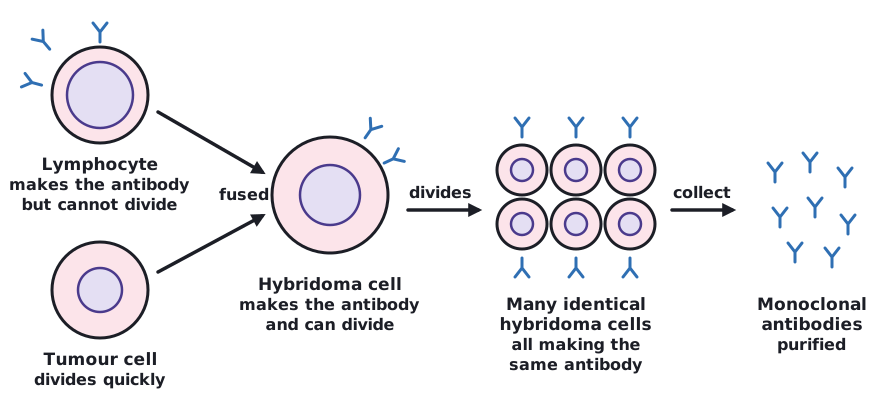
Flow diagram: a lymphocyte that makes the antibody but cannot divide is fused with a tumour cell that divides quickly to form a hybridoma cell, which divides into many identical hybridoma cells making the same antibody, which are collected as purified monoclonal antibodies. (opens full size in a new tab)
A hybridoma cell makes the antibody like a lymphocyte and divides like a tumour cell.

Written and checked against the Edexcel GCSE Biology (1BI0) specification · Updated October 2026

Frequently asked questions

Why can't antibiotics kill viruses?

Antibiotics cannot kill viruses because they work by inhibiting cell processes in bacteria, and viruses are not cells. Viruses live and reproduce inside host cells, so they do not have the cell processes that antibiotics target. This is why antibiotics cannot be used to treat viral diseases such as HIV, colds or flu.

What are the stages of developing a new medicine?

New medicines go through four stages: discovery of a chemical that might treat the disease, development to improve it, preclinical testing on cells, tissues and live animals to check toxicity and effectiveness, and clinical testing on people. Clinical testing starts with a few healthy volunteers to check safety, then patients to find the dose.

Why are bacterial cultures incubated at 25 °C?

Triple only Bacterial cultures are incubated at 25 °C because a lower temperature makes it less likely that harmful pathogens, which grow best at body temperature, will grow. The lid is taped on but not fully sealed, so microorganisms cannot escape or get in, but oxygen can still enter. The dish is incubated upside down.

All 5 questions on Antibiotics, culturing microorganisms and new medicines