
Book a tutor

Transpiration and stomata

Plant structures and their functions · Transport in plants · note 3 of 4

Transpiration and stomataSpec 6.9

In short

Transpiration is the loss of water vapour from a plant, mainly through the stomata in the leaves. It pulls the transpiration stream of water and mineral ions up the xylem from the roots. Guard cells control the stomata: they swell and open the stoma when they take in water, and become limp and close it when they lose water.

Transpiration is the loss of water vapour from a plant, mainly through the stomata in the leaves. It pulls a continuous stream of water, called the transpiration stream, through the plant. This is how water and mineral ions are transported from the roots to the leaves.

  1. Water is absorbed from the soil by the root hair cells.
  2. Water and dissolved mineral ions move up through the xylem to the leaves.
  3. Water evaporates from the surface of the cells inside the leaf, into the air spaces.
  4. Water vapour diffuses out of the leaf through the stomata, into the air.
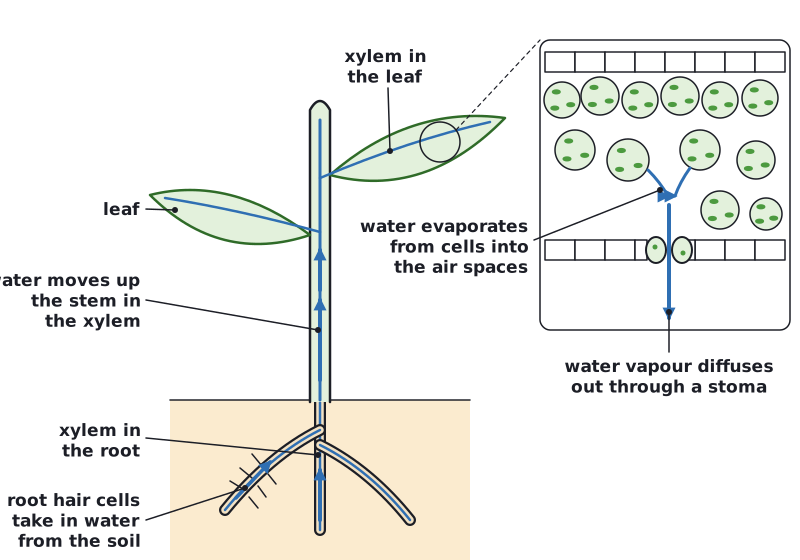
A plant showing water taken in by root hair cells, moving up the xylem in the root, stem and leaf, then a magnified leaf section where water evaporates from cells into the air spaces and water vapour diffuses out through a stoma. (opens full size in a new tab)
The transpiration stream: water moves up the xylem, evaporates into the air spaces and diffuses out through the stomata.

Stomata

Stomata are tiny pores, found mainly on the underside of a leaf. Each stoma is surrounded by two guard cells which control whether the stoma is open or closed.

  • Open stomata let carbon dioxide diffuse into the leaf for photosynthesis, and let oxygen and water vapour diffuse out.
  • When the guard cells take in water they swell and the stoma opens.
  • When the guard cells lose water they become limp and the stoma closes. This reduces the amount of water lost by transpiration, for example when the plant is short of water.
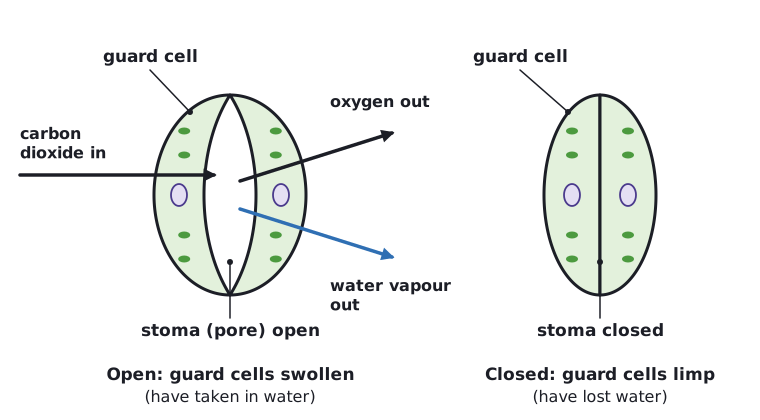
Surface views of a stoma: open, with swollen guard cells, carbon dioxide going in and oxygen and water vapour going out; closed, with limp guard cells and no pore. (opens full size in a new tab)
Guard cells that take in water swell and open the stoma; guard cells that lose water go limp and close it.
Exam tip:

Water is lost from the leaf by evaporation and then diffusion. Do not say that water 'escapes' or 'leaks'. Use the terms evaporates and diffuses.

Written and checked against the Edexcel GCSE Biology (1BI0) specification · Updated October 2026

Frequently asked questions

How are root hair cells adapted to their function?

Root hair cells are adapted to absorb water and mineral ions from the soil. The long, thin root hair gives a large surface area, and the thin cell wall gives a short distance to cross. Many mitochondria release energy for the active transport of mineral ions, and concentrated cell sap lets water enter by osmosis.

Why is active transport needed in plant roots?

Active transport is needed because mineral ions, such as nitrate ions, are usually at a lower concentration in the soil water than inside the root hair cell. They cannot move in by diffusion, so they are moved from a lower to a higher concentration by active transport, which uses energy released by respiration in the mitochondria.

How does water move from roots to leaves?

Water moves from roots to leaves in the transpiration stream. Water is absorbed from the soil by root hair cells and moves up through the xylem to the leaves. It evaporates from the cells inside the leaf into the air spaces and diffuses out through the stomata. This loss of water pulls more water up the xylem.

All 5 questions on Transport in plants