
Pyramids of number, biomass and energySpec 4.7
In short
Ecological pyramids use bars to compare the trophic levels in a food chain, with producers at the bottom. A pyramid of number counts organisms and can be inverted, for example one oak tree supporting many caterpillars. A pyramid of biomass shows the mass of living material and almost always narrows, while a pyramid of energy transfer always narrows upwards.
Pyramids use bars to compare the trophic levels in a food chain, with trophic level 1 at the bottom. There are three types.
| Pyramid | What each bar shows | Shape |
|---|---|---|
| Pyramid of number | The number of organisms at each trophic level | Often a pyramid, but can be inverted |
| Pyramid of biomass | The mass of living material at each trophic level | Almost always narrows at each level |
| Pyramid of energy transfer | The amount of energy transferred to each trophic level, for example in kJ per m² per year | Always narrows at each level |
Pyramids of number
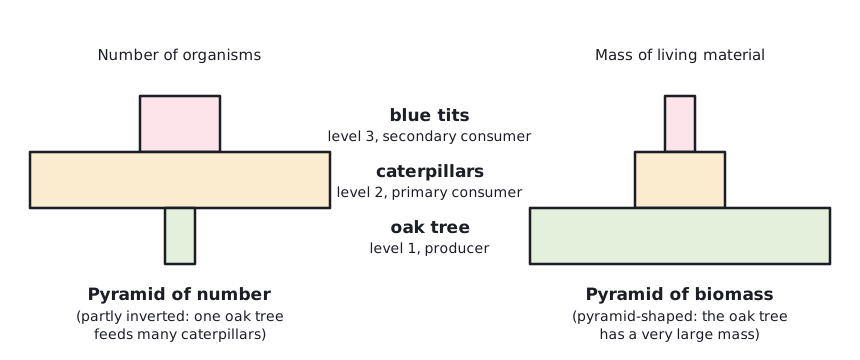
A pyramid of number counts the organisms but ignores their size. Where one large producer supports many small consumers, such as one oak tree supporting thousands of caterpillars, the bottom bar is narrower than the bar above it, so the pyramid is not pyramid-shaped. It is partly or fully inverted. Parasites can do the same: one fox may carry hundreds of fleas. A pyramid of biomass for the same chain is pyramid-shaped, because the oak tree has a very large mass.
 (opens full size in a new tab)
Pyramids of biomass
Each bar shows the mass of living material at that trophic level, and it almost always gets narrower at each higher level. To draw one, choose a scale so the length of each bar is proportional to its biomass, put trophic level 1 at the bottom and centre the bars on a vertical line.
Drawing a pyramid to scale
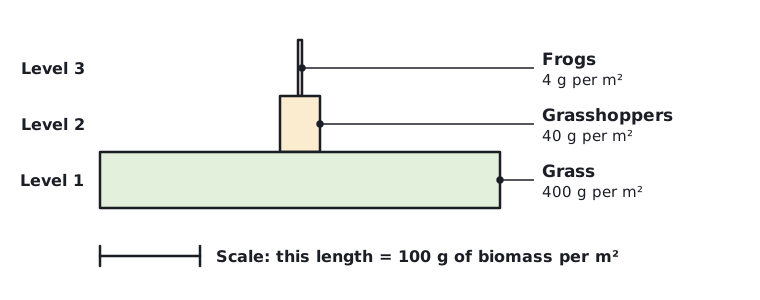
A food chain has biomass of 400 g per m² of grass, 40 g per m² of grasshoppers and 4 g per m² of frogs. Describe how to construct the pyramid using a scale of 1 mm = 4 g.
- Grass: 400 ÷ 4 = a bar 100 mm long, at the bottom.
- Grasshoppers: 40 ÷ 4 = a bar 10 mm long, above the grass.
- Frogs: 4 ÷ 4 = a bar 1 mm long, at the top.
Answer: Three centred bars of 100 mm, 10 mm and 1 mm, with grass at the bottom and frogs at the top.
 (opens full size in a new tab)
Pyramids of energy transfer
A pyramid of energy transfer shows how much energy is transferred to each trophic level in a given time. It is always pyramid-shaped, because energy is lost at every step, so each level receives less than the one below.
Pyramids of number are often inverted. Pyramids of energy transfer never are. If a question shows a pyramid that is not pyramid-shaped, it is most likely a pyramid of number.
Written and checked against the Edexcel IGCSE Biology (4BI1) specification · Updated October 2026