
Book a tutor

Water uptake by root hair cells

Structure and functions in living organisms · The need for transport and transport in plants · note 3 of 5

Spec 2.55B
Biology only (what this means)Biology only: only in International GCSE Biology. Double Award students can skip it. What the labels mean
Download all The need for transport and transport in plants notes (PDF)Download all notes (PDF)9 pages

Water uptake by root hair cellsSpec 2.55B

In short

Root hair cells absorb water from the soil by osmosis and mineral ions by active transport. Soil water is more dilute than the cell sap, so water moves into the cell through the partially permeable membrane. The long, thin root hair gives a large surface area, and many mitochondria release energy for the active transport of mineral ions.

Root hair cells are found near the tips of roots. Each has a long, thin projection (the root hair) that reaches between the soil particles. They absorb water and mineral ions from the soil.

How water is absorbed

  1. Soil water is a dilute solution, so it has a higher concentration of water molecules than the cell sap inside the root hair cell.
  2. Water moves into the cell by osmosis: from the dilute solution outside to the more concentrated cell sap, through the partially permeable cell membrane.
  3. The water then passes from cell to cell across the root into the xylem, which carries it up the plant.
Adaptations of a root hair cell
AdaptationHow it helps
Long, thin projection (the root hair)Large surface area, so more water can be absorbed
Thin cell wall and membraneShort diffusion distance for water
Cell sap more concentrated than the soil waterKeeps a concentration gradient so water moves in by osmosis
Many mitochondriaRelease energy for the active transport of mineral ions into the cell

Mineral ions, such as nitrate, are usually at a lower concentration in the soil than inside the cell. They are taken in by active transport against the concentration gradient, which needs energy from respiration.
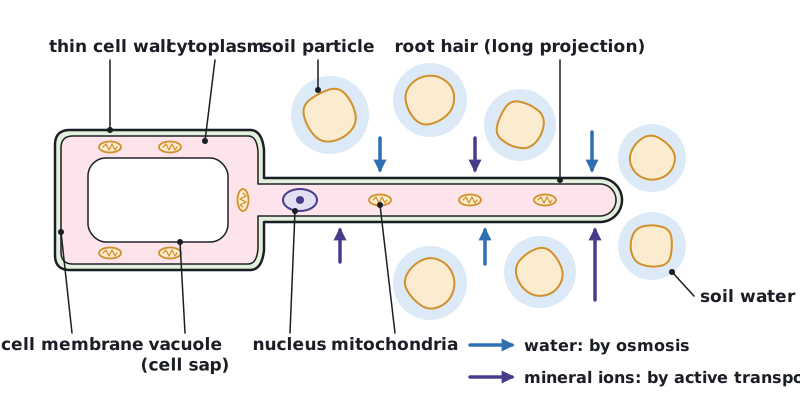
A root hair cell in soil, labelled thin cell wall, cytoplasm, cell membrane, vacuole with cell sap, nucleus, mitochondria and the long root hair, with arrows for water entering by osmosis and mineral ions by active transport. (opens full size in a new tab)
A root hair cell: water enters by osmosis; mineral ions enter by active transport using energy from the mitochondria.
Exam tip:

For an 'explain' question, link each adaptation to its function: 'the root hair gives a large surface area, so more water can be absorbed'.

Written and checked against the Edexcel IGCSE Biology (4BI1) specification · Updated October 2026

Frequently asked questions

Why is diffusion insufficient in multicellular organisms?

Diffusion is insufficient in multicellular organisms because they have a small surface area to volume ratio and most cells are deep inside the body. Diffusion over these long distances is too slow to supply every cell with enough oxygen and food, or to remove waste quickly. So they need transport systems, such as blood, or xylem and phloem.

What is the difference between xylem and phloem?

Xylem carries water and mineral ions upwards from the roots, while phloem carries sucrose and amino acids up or down the plant to where they are needed. Xylem is made of dead, hollow cells with walls strengthened by lignin. Phloem is made of living cells joined end to end, with sieve plates in the end walls.

How are root hair cells adapted to their function?

Biology only Root hair cells have a long, thin projection that gives a large surface area for absorbing water and mineral ions. A thin wall and membrane give a short distance for water. Cell sap more concentrated than soil water keeps water moving in by osmosis, and many mitochondria release energy for active transport of mineral ions.

All 5 questions on The need for transport and transport in plants