
Book a tutor

Enzymes as biological catalysts

Structure and functions in living organisms · Biological molecules and enzymes · note 3 of 5

Enzymes as biological catalystsSpec 2.10

In short

Enzymes are proteins that act as biological catalysts, speeding up metabolic reactions without being used up. The substrate has a shape complementary to the enzyme's active site, so it fits like a key in a lock and forms an enzyme-substrate complex. Enzymes are specific: each catalyses only one type of reaction.

Metabolic reactions are the chemical reactions that happen in living cells. They are controlled by enzymes. Enzymes are proteins that act as biological catalysts. A catalyst speeds up a reaction without being used up. Each enzyme has a region called the active site, which has a particular shape.

The molecule an enzyme acts on is called the substrate. The substrate has a shape that is complementary to the active site, so it fits in, like a key in a lock. This is called the lock and key model.

  1. The substrate collides with the active site of the enzyme.
  2. The substrate fits into the active site, forming an enzyme-substrate complex.
  3. The reaction takes place at the active site.
  4. The product or products leave the active site and the enzyme is free to be used again.

Enzymes are specific. Only a substrate with a shape that fits the active site can bind to it, so each enzyme catalyses only one type of reaction.
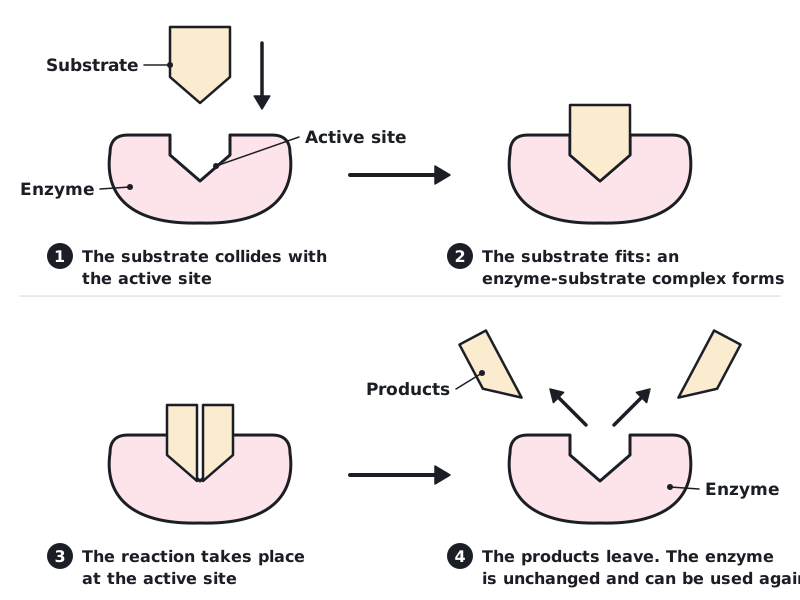
Four-step lock and key model: the substrate collides with the active site, fits to form an enzyme-substrate complex, the reaction takes place, then the products leave and the enzyme is unchanged. (opens full size in a new tab)
The lock and key model. The substrate is complementary to the active site, and the enzyme is not used up.
Exam tip:

The mark scheme word is complementary. Say the shape of the substrate is complementary to the shape of the active site, not that they are 'the same'.

Written and checked against the Edexcel IGCSE Biology (4BI1) specification · Updated October 2026

Frequently asked questions

How do enzymes speed up reactions?

Enzymes speed up reactions by acting as biological catalysts. The substrate fits into the enzyme's active site because their shapes are complementary, forming an enzyme-substrate complex. The reaction takes place at the active site, then the products leave and the enzyme is free to be used again, because it is not used up.

Why do enzymes denature at high temperatures?

Enzymes denature at high temperatures because the heat damages the enzyme's structure, so the shape of the active site changes. The substrate is no longer complementary to the active site and cannot fit, so the rate of reaction falls quickly towards zero. Denaturing is permanent, and enzymes are not alive, so they are not 'killed'.

What happens to enzymes at low temperatures?

At low temperatures enzymes work slowly but are not denatured. The enzyme and substrate particles have less kinetic energy and move more slowly, so they collide less often and fewer enzyme-substrate complexes form. As the temperature rises towards the optimum, around 37 °C for many human enzymes, collisions increase and the rate rises.

All 5 questions on Biological molecules and enzymes