
Family pedigrees and probabilitiesSpec 3.24, 3.25
In short
A family pedigree is a family tree showing who has a characteristic. If two parents without the characteristic have a child with it, it is recessive and both parents are carriers. Outcomes can be given as a ratio, probability or percentage: two carriers, Ff × Ff, have a 1 in 4, or 25%, probability of an affected child.
A family pedigree (family tree) shows who in a family has a characteristic. Squares are usually males and circles are females. Shaded shapes show people with the characteristic. A horizontal line joins the parents and a vertical line leads down to their children.
- If two parents who do not have a characteristic have a child who does, the characteristic is recessive. Both parents must be carriers: heterozygous, with one copy of the recessive allele.
- If two parents who both have a characteristic have a child who does not, the characteristic is dominant. Both parents must be heterozygous.
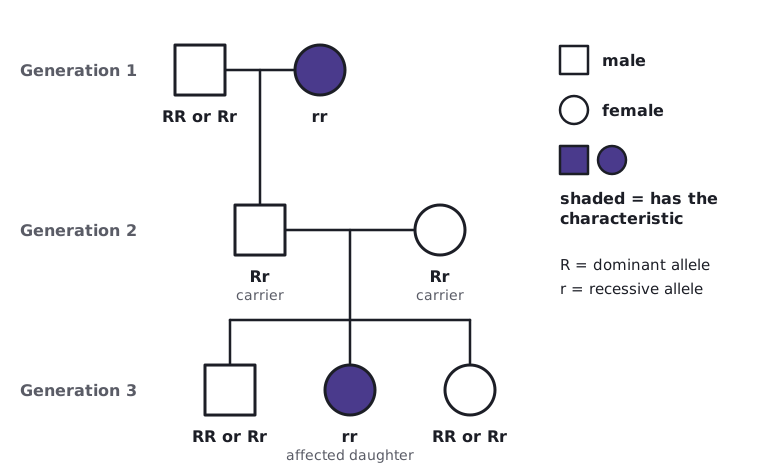 (opens full size in a new tab)
Predicting probabilities
You can predict the outcome of a monohybrid cross as a ratio, a probability or a percentage.
| Outcome | Boxes out of 4 | Probability | Percentage |
|---|---|---|---|
| Short plant (tt) | 1 | 1/4 or 0.25 | 25% |
| Tall plant (TT or Tt) | 3 | 3/4 or 0.75 | 75% |
Probability for a recessive disorder
A disorder is caused by a recessive allele (f). Two parents do not have the disorder but both are carriers (Ff). What is the probability that their child has the disorder?
- Gametes from each parent: F or f.
- Possible offspring: FF, Ff, Ff and ff.
- Only ff has the disorder. That is 1 out of 4 equally likely outcomes.
Answer: Probability = 1/4 = 0.25 = 25%.
Each child is an independent event. If the first child has the disorder, the probability for the next child is still 1 in 4. Probabilities describe chance. They do not guarantee the actual numbers in a family.
A 3 : 1 ratio means 1 in 4 offspring show the recessive feature, not 1 in 3. Count the favourable boxes out of the total.
In a pedigree question, find two parents with the same phenotype and a child with the other phenotype. That tells you which allele is dominant.
Written and checked against the Edexcel IGCSE Biology (4BI1) specification · Updated October 2026