
Micropropagation (tissue culture)Spec 5.17B, 5.18B
In short
Micropropagation, or tissue culture, is growing new plants from small pieces of plant tissue called explants in vitro. Sterilised explants are placed on sterile nutrient agar containing nutrients and plant growth hormones, using aseptic technique. They grow into plantlets that are genetically identical to the parent, so commercial quantities of plants with desirable characteristics are produced quickly.
Micropropagation (tissue culture) is growing new plants from small pieces of a plant, called explants, in vitro. In vitro means in glass or a container, not in the soil.
- Take small pieces of tissue (explants) from the parent plant, for example from the shoot tip.
- Sterilise the explants and use aseptic technique so that bacteria and fungi do not contaminate the culture.
- Place the explants on a sterile nutrient agar containing nutrients and plant growth hormones.
- The cells divide and grow into small plantlets. These can be transferred to fresh medium and then planted out.
Uses and advantages
- Commercial quantities of genetically identical plants can be produced quickly from a small amount of tissue.
- Plants with desirable characteristics, such as high yield, are copied exactly.
- Plants can be produced all year round, in a small space.
- Rare plants can be reproduced to help save them.
The key word is 'identical'. The new plants are clones of the parent, so the useful characteristics are kept.
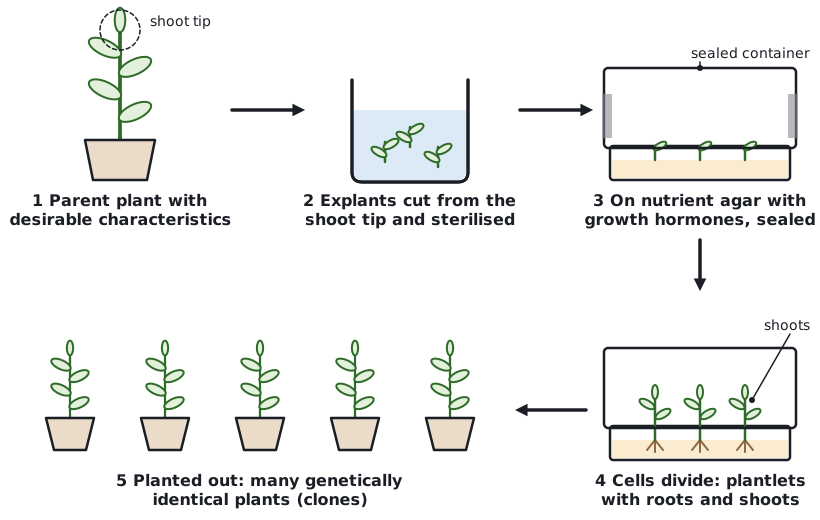 (opens full size in a new tab)
Written and checked against the Edexcel IGCSE Biology (4BI1) specification · Updated October 2026