
Book a tutor

Germination and food reserves

Reproduction and inheritance · Sexual and asexual reproduction, and reproduction in plants · note 4 of 6

Germination and food reservesSpec 3.6

In short

Germination is when a seed begins to grow into a seedling. During germination, enzymes break down the food reserves in the seed into soluble molecules: starch to sugars, oils to fatty acids and glycerol, and proteins to amino acids. These are used in respiration and growth until the first leaves can photosynthesise.

Germination is when a seed begins to grow into a seedling. A seed contains an embryo plant and a store of food. The food reserves are mainly starch and oils (fats), with some protein, stored in the cotyledons or in a separate food store.

When a seed germinates, enzymes break down the stored food into smaller soluble molecules: starch to sugars, oils to fatty acids and glycerol, and proteins to amino acids. Sugars are used in respiration to release energy. The products are also used to make new cells for growth.

A young seedling cannot make its own food at first. It uses the food reserves until its first leaves have grown above the soil and can carry out photosynthesis.

  1. The seed takes in water and swells.
  2. Enzymes break down the stored starch and oil into soluble substances.
  3. The root grows downwards and the shoot grows upwards, using energy from respiration.
  4. The first leaves reach the light and start to photosynthesise.
  5. The seedling no longer relies on the food reserves.
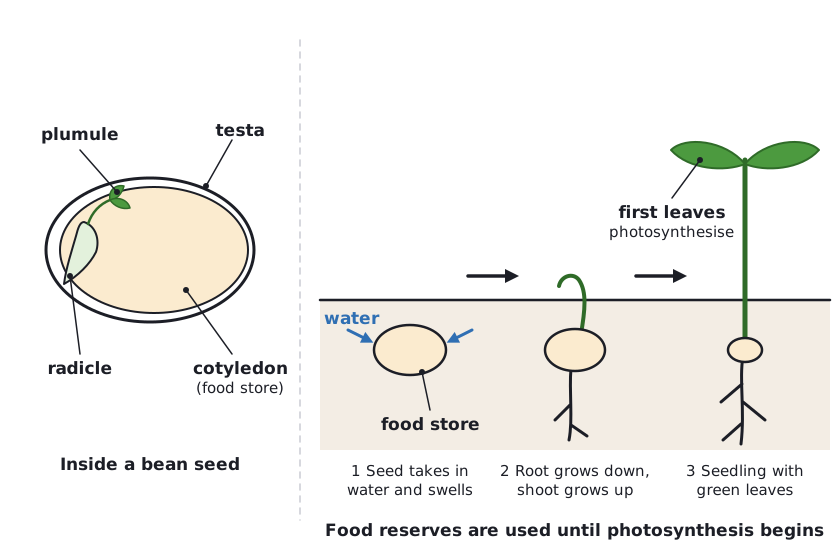
Inside a bean seed: testa, cotyledon (food store), plumule and radicle; then three stages of germination in soil: the seed takes in water and swells, the root grows down and the shoot grows up, and a seedling with green leaves that photosynthesise, with the food store getting smaller at each stage. (opens full size in a new tab)
The seed's food reserves are used up as it germinates, until the first leaves can photosynthesise.
Exam tip:

The dry mass of a germinating seed falls at first, because food reserves are used up in respiration and it cannot yet photosynthesise. Dry mass only increases once the leaves start photosynthesising.

Written and checked against the Edexcel IGCSE Biology (4BI1) specification · Updated October 2026

Frequently asked questions

What is the difference between sexual and asexual reproduction?

Sexual reproduction involves two parents and the fusion of male and female gametes, so the offspring are genetically different from each other and the parents. Asexual reproduction involves one parent and no gametes. The offspring are made by mitosis, so they are genetically identical clones and the population has very little variation.

How are wind-pollinated flowers adapted?

Wind-pollinated flowers have anthers that hang outside the flower on long filaments, so the wind can blow the pollen away. They make very large amounts of light, smooth pollen. Their large, feathery stigmas hang outside the flower to catch pollen from the air, and their petals are small and dull because insects are not needed.

What is the difference between pollination and fertilisation in plants?

Pollination is the transfer of pollen grains from an anther to a stigma. Fertilisation happens afterwards, when a pollen tube has grown down the style into an ovule and the male gamete nucleus fuses with the egg cell nucleus. The fertilised ovule then becomes a seed and the ovary becomes a fruit.

All 5 questions on Sexual and asexual reproduction, and reproduction in plants