
Practical: diffusion and osmosisSpec 2.17
In short
Diffusion and osmosis can be investigated with living systems such as potato cylinders and non-living systems such as Visking tubing and agar cubes. Potato cylinders gain mass in dilute solutions and lose mass in concentrated ones because water moves by osmosis. Glucose diffuses through Visking tubing but starch cannot, and small agar cubes change colour fastest.
You need to be able to investigate diffusion and osmosis using living systems (such as potato tissue) and non-living systems (such as Visking tubing and agar).
Living system: osmosis in potato cylinders
Independent variable: concentration of the solution; dependent variable: change in mass. Blot each cylinder dry before you weigh it, because surface water adds mass that is not from osmosis.
- Use a cork borer to cut cylinders from one potato, and trim them to the same length.
- Measure and record the mass of each cylinder.
- Put each cylinder in a different concentration of sugar (or salt) solution, including pure water, using the same volume of solution each time.
- Leave them for the same length of time at the same temperature.
- Remove the cylinders, blot them dry with paper towel and measure their final mass.
- Calculate the percentage change in mass for each cylinder and plot a graph of percentage change against concentration.
| Result | Explanation |
|---|---|
| Mass increases | The solution is more dilute than the cell contents, so water moves into the potato by osmosis |
| Mass decreases | The solution is more concentrated than the cell contents, so water moves out of the potato by osmosis |
| No change in mass | The solution has the same concentration as the cell contents, so there is no net movement of water |
Percentage change in mass
A potato cylinder has a mass of 3.00 g. After 30 minutes in a salt solution its mass is 2.55 g. Calculate the percentage change in mass.
- change in mass = 2.55 − 3.00 = −0.45 g
- −0.45 ÷ 3.00 = −0.15
- −0.15 × 100 = −15%
Answer: −15% (a loss of 15%)
Where the graph line crosses the x-axis (0% change), the concentration of the solution equals the concentration of the potato cell contents. Control the potato, the size of the cylinders, the volume of the solution, the time and the temperature. Cut on a tile away from your fingers, because cork borers and scalpels are sharp.
Non-living system: Visking tubing
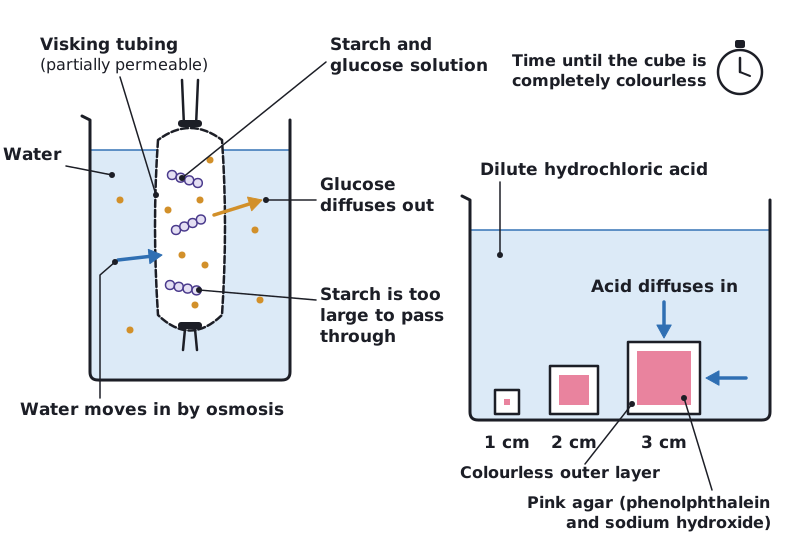
Visking tubing is a partially permeable membrane with tiny pores. It lets small molecules such as water and glucose through, but not large molecules such as starch.
- Tie one end of a length of soaked Visking tubing and fill it with a mixture of starch and glucose solution. Tie the other end.
- Rinse the outside, then place the tube in a beaker of water.
- After about 20 to 30 minutes, test the water in the beaker with Benedict's solution (for glucose) and with iodine solution (for starch).
Typical results: the water in the beaker gives a positive Benedict's test, so glucose has diffused out through the pores. It does not turn blue-black with iodine, so the starch molecules were too large to pass through. To show osmosis, fill the tube with a concentrated sugar solution and place it in water. The tube becomes firmer and gains mass as water moves in.
Non-living system: agar cubes
Agar jelly cubes can show diffusion and the effect of surface area to volume ratio. Make agar containing phenolphthalein indicator and a little dilute sodium hydroxide (an alkali), so it is pink. Cut cubes of different sizes, for example 1 cm, 2 cm and 3 cm. Place each cube in the same volume of dilute hydrochloric acid at the same temperature. As the acid diffuses in, it neutralises the alkali and the indicator turns colourless. Time how long each cube takes to become completely colourless.
Typical results: small cubes, with a larger surface area : volume ratio and a shorter distance to the centre, change colour all the way through sooner than large cubes. Wear eye protection when using acid and alkali.
 (opens full size in a new tab)
Quick check
Define diffusion.
Show answer
The net movement of particles from an area of higher concentration to an area of lower concentration.
What is osmosis?
Show answer
The diffusion of water from a dilute solution to a more concentrated solution through a partially permeable membrane.
Which of diffusion, osmosis and active transport needs energy from respiration?
Show answer
Active transport.
What happens to the surface area to volume ratio as an organism gets bigger?
Show answer
It gets smaller.
Why does a potato cylinder lose mass in a concentrated sugar solution?
Show answer
Water moves out of the potato cells into the more concentrated solution by osmosis.
Written and checked against the Edexcel IGCSE Biology (4BI1) specification · Updated October 2026