
Focusing and the pupil reflexSpec 2.92
In short
The eye focuses by changing the shape of the lens. For a near object the ciliary muscles contract, the suspensory ligaments loosen and the lens becomes thicker. For a distant object the reverse happens. In bright light the circular muscles of the iris contract and the pupil gets smaller, protecting the retina; in dim light the radial muscles contract.
The eye can focus on both near and distant objects. The lens changes shape to do this. The ciliary muscles (a ring of muscle around the lens) and the suspensory ligaments (which hold the lens in place) control the lens shape.
| Near object | Distant object | |
|---|---|---|
| Ciliary muscles | Contract | Relax |
| Suspensory ligaments | Loosen | Pulled tight |
| Lens shape | Thicker (more curved) | Pulled thin (flatter) |
| Refraction of light | Light rays refracted more | Light rays refracted less |
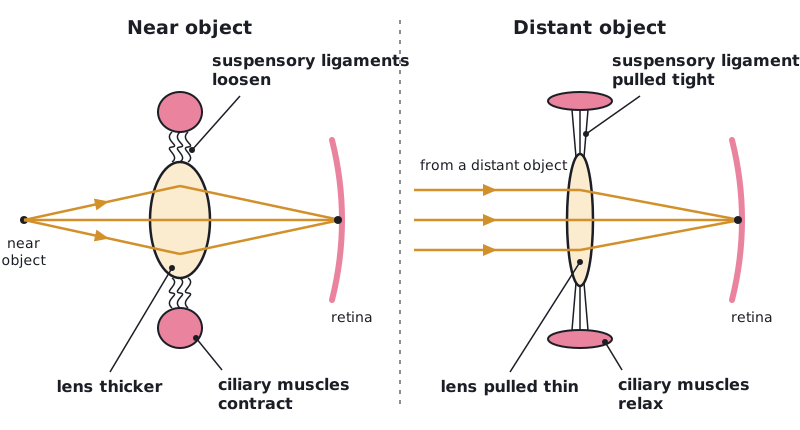 (opens full size in a new tab)
For a near object the ciliary muscles contract and the ligaments go slack. Many students reverse this. Remember: contracted muscle, loose ligaments, fat lens.
Changes in light intensity: the pupil reflex
The size of the pupil changes automatically in response to light intensity. This is a reflex, so it is fast and protects the retina. The iris has two sets of muscle: circular muscles (in rings around the pupil) and radial muscles (running out from the pupil like spokes).
| Bright light | Dim light | |
|---|---|---|
| Circular muscles | Contract | Relax |
| Radial muscles | Relax | Contract |
| Pupil | Gets smaller (constricts) | Gets larger (dilates) |
| Effect | Less light enters, so the retina is protected from damage | More light enters, so you can see better |
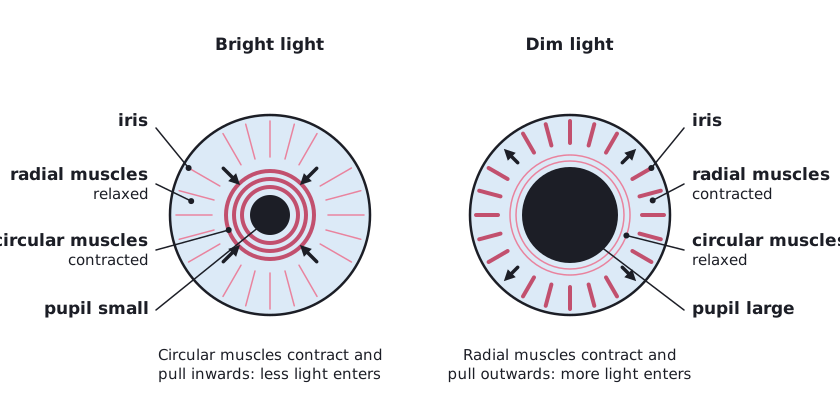 (opens full size in a new tab)
Name the muscles and say what each does. ‘Circular muscles contract’ makes the pupil smaller; ‘radial muscles contract’ makes it larger.
Quick check
What two organs make up the central nervous system?
Show answer
The brain and the spinal cord.
What carries the message across a synapse?
Show answer
A neurotransmitter, which diffuses across the gap.
Name the three types of neurone in a reflex arc, in order.
Show answer
Sensory neurone, relay neurone, motor neurone.
Which part of the eye contains the light receptors?
Show answer
The retina.
In bright light, do the circular muscles of the iris contract or relax?
Show answer
They contract, making the pupil smaller.
Written and checked against the Edexcel IGCSE Biology (4BI1) specification · Updated October 2026