
Arteries, veins and capillariesSpec 2.68
In short
Arteries, veins and capillaries are the three types of blood vessel. Arteries carry blood away from the heart at high pressure, so they have thick, muscular walls with elastic fibres. Veins carry blood back to the heart at low pressure, with a wide lumen and valves to stop backflow. Capillaries have walls one cell thick for exchanging substances with cells.
There are three types of blood vessel. Each has a structure that suits its function.
| Artery | Vein | Capillary | |
|---|---|---|---|
| Direction of blood | Away from the heart | Towards the heart | Between arteries and veins, through the tissues |
| Blood pressure | High | Low | Falls as blood passes through |
| Wall | Thick, muscular, with elastic fibres | Thinner wall | One cell thick |
| Lumen | Narrow | Wide | Very narrow |
| Valves | No | Yes | No |
| Function | Carry blood at high pressure to the organs | Carry blood back to the heart | Exchange substances with cells |
- Arteries have thick, muscular walls with elastic fibres. The wall can stand the high pressure, and it stretches and springs back with each heartbeat.
- Veins carry blood at low pressure. They have a wide lumen, which lets blood flow easily, and valves to stop the blood flowing backwards.
- Capillaries have walls only one cell thick, so there is a short diffusion distance. They are very narrow and form a huge network, so they reach every cell and give a large surface area for exchange.
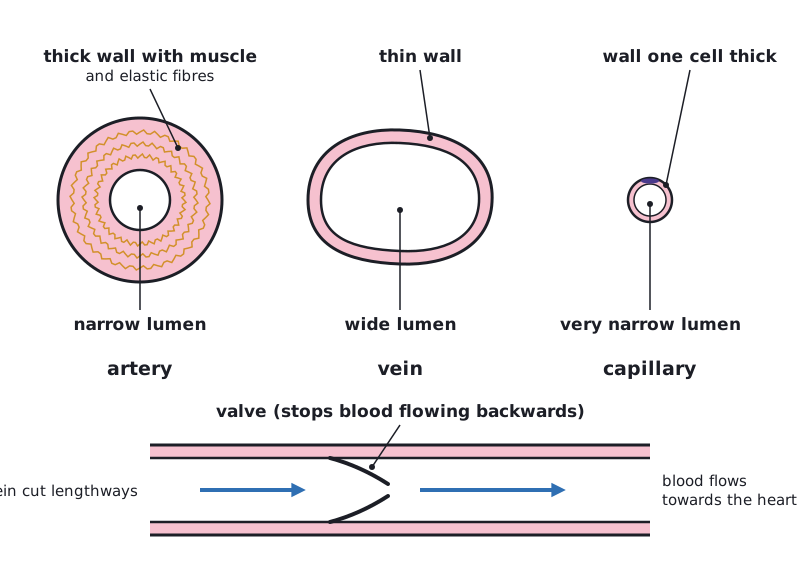 (opens full size in a new tab)
Exam tip:
Do not say that arteries always carry oxygenated blood and veins always carry deoxygenated blood. The pulmonary artery and pulmonary vein are the exceptions.
Written and checked against the Edexcel IGCSE Biology (4BI1) specification · Updated October 2026