
Gas exchange, diffusion and stomataSpec 2.40B, 2.41B, 2.43B, 2.70
In short
Metabolism is all the chemical reactions in a cell, and two of its products are waste products in a plant. Carbon dioxide is a waste product of respiration, and oxygen is a waste product of photosynthesis. Both gases leave the plant from the leaves by diffusion through the stomata.
Waste products of metabolism
Metabolism is all the chemical reactions in a cell. Two of its products are waste products in a plant. Carbon dioxide is a waste product of respiration. Oxygen is a waste product of photosynthesis. Both leave the plant from the leaves by diffusion through the stomata.
Biology only (what this means)
Biology only: only in International GCSE Biology. Double Award students can skip it. What the labels meanDiffusion in gas exchange
Biology only (what this means)
Biology only: only in International GCSE Biology. Double Award students can skip it. What the labels meanDiffusion is the net movement of particles from a region of higher concentration to a region of lower concentration, down a concentration gradient. Gases move into and out of leaves by diffusion, so no energy is needed to move them.
Biology only (what this means)
Biology only: only in International GCSE Biology. Double Award students can skip it. What the labels meanPlants use and make both gases. Gas exchange of carbon dioxide and oxygen therefore depends on two processes at the same time.
Biology only (what this means)
Biology only: only in International GCSE Biology. Double Award students can skip it. What the labels mean| Process | Takes in | Gives out | When it happens |
|---|---|---|---|
| Respiration | Oxygen | Carbon dioxide | All the time, in light and dark |
| Photosynthesis | Carbon dioxide | Oxygen | Only when there is light |
Biology only (what this means)
Biology only: only in International GCSE Biology. Double Award students can skip it. What the labels meanGases reach the mesophyll cells through the stomata and the air spaces inside the leaf. How the structure of the leaf is adapted for gas exchange is covered in Leaf structure and adaptations.
Biology only (what this means)
Biology only: only in International GCSE Biology. Double Award students can skip it. What the labels meanThe role of stomata
Biology only (what this means)
Biology only: only in International GCSE Biology. Double Award students can skip it. What the labels meanA stoma is a pore in the leaf surface. It is surrounded by two guard cells. When the guard cells take in water they swell and the stoma opens. When they lose water they become limp and the stoma closes. Carbon dioxide enters and oxygen leaves through open stomata. Water vapour is also lost through them, so the plant closes its stomata when it loses too much water.
Biology only (what this means)
Biology only: only in International GCSE Biology. Double Award students can skip it. What the labels mean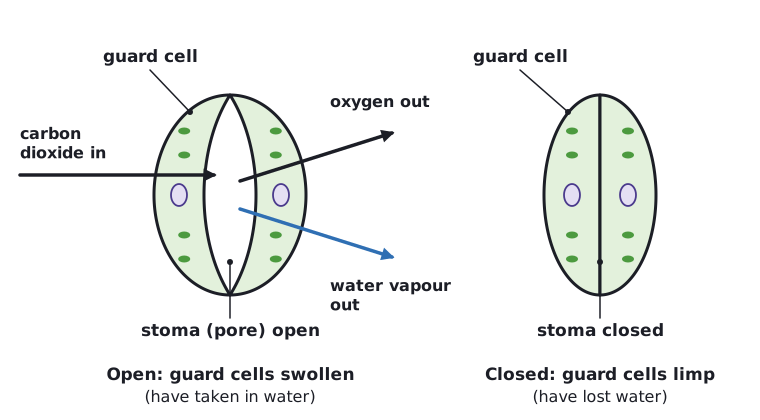 (opens full size in a new tab)
Biology only (what this means)
Biology only: only in International GCSE Biology. Double Award students can skip it. What the labels meanIn the day, carbon dioxide diffuses into the leaf because photosynthesis uses it up, so its concentration inside the leaf is lower than in the air.
Written and checked against the Edexcel IGCSE Biology (4BI1) specification · Updated October 2026