
Practical: light and net gas exchangeSpec 2.45B
In short
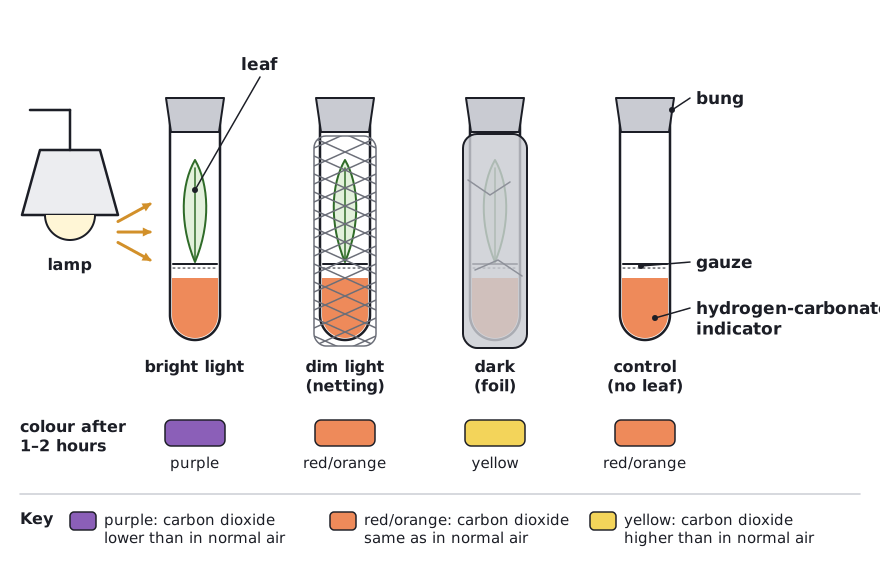
Hydrogen-carbonate indicator shows net gas exchange in leaves: it is red/orange in normal air, turns yellow when carbon dioxide rises and purple when it falls. A leaf in bright light turns it purple because photosynthesis is faster than respiration. A leaf in darkness turns it yellow because only respiration happens. A tube with no leaf is the control.
Hydrogen-carbonate indicator changes colour as the carbon dioxide concentration of the air around it changes. It turns yellow when carbon dioxide rises and purple when carbon dioxide falls. You can use it to see whether a leaf takes in or releases carbon dioxide in different light intensities.
| Colour | Carbon dioxide concentration |
|---|---|
| Red/orange (starting colour) | Same as in normal air |
| Yellow | Higher than normal air (carbon dioxide has been added) |
| Purple | Lower than normal air (carbon dioxide has been removed) |
- Put the same volume of hydrogen-carbonate indicator into four boiling tubes.
- Put a similar leaf (same size and mass) into three of the tubes, held above the indicator on gauze or a wire so it does not touch the liquid. Leave the fourth tube with no leaf as a control.
- Seal each tube with a bung.
- Place the first tube in bright light. Place the second in dim light (wrapped in one layer of gauze or netting). Wrap the third completely in foil so it is in darkness.
- Leave all the tubes for the same time, for example one to two hours, at the same distance from the lamp. Do not breathe into the tubes, as this adds carbon dioxide.
- Record the colour of the indicator in each tube.
| Tube | Colour after the time | Explanation |
|---|---|---|
| Bright light | Purple | Photosynthesis faster than respiration, so net uptake of carbon dioxide |
| Dim light | Stays red/orange | Photosynthesis about equal to respiration, so no net change |
| Dark (foil) | Yellow | Only respiration, so net release of carbon dioxide |
| No leaf (control) | Stays red/orange | Shows the colour change is caused by the leaf |
| Type of variable | Example |
|---|---|
| Independent variable | Light intensity (bright, dim, dark) |
| Dependent variable | Colour of the hydrogen-carbonate indicator |
| Control variables | Size and mass of leaf, volume of indicator, time, temperature, distance from the lamp |
Put a water tank (heat shield) between the lamp and the tubes so that heat from the lamp does not change the temperature. The lamp gets hot, so do not touch it. The dim light result depends on the light level: the indicator may turn slightly yellow or slightly purple.
 (opens full size in a new tab)
Quick check
Biology only Name the process by which gases move into and out of a leaf.
Show answer
Diffusion.
Biology only What do guard cells do?
Show answer
They open and close the stoma.
Which gas is a waste product of photosynthesis and leaves through the stomata?
Show answer
Oxygen.
Biology only What is happening at the compensation point?
Show answer
The rate of photosynthesis equals the rate of respiration, so there is no net gas exchange.
Biology only What colour does hydrogen-carbonate indicator turn when carbon dioxide is added?
Show answer
Yellow.
Written and checked against the Edexcel IGCSE Biology (4BI1) specification · Updated October 2026