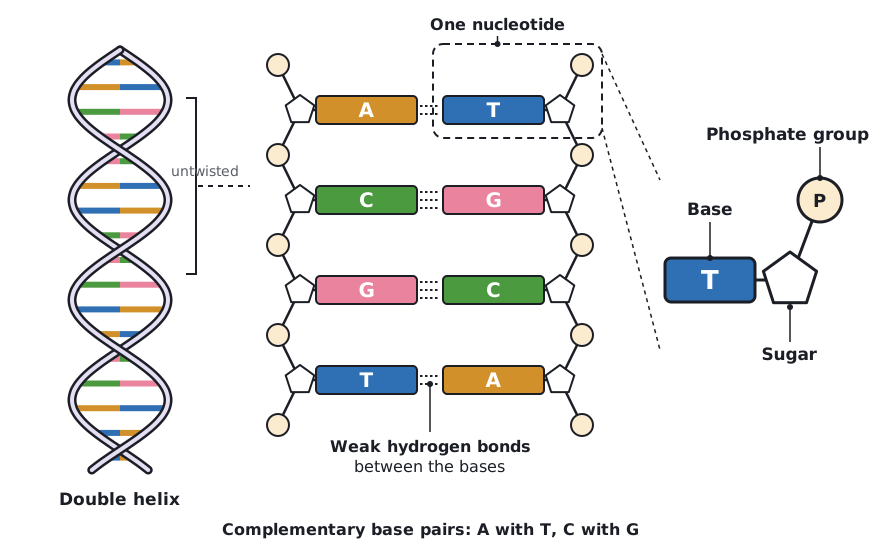
DNA is a molecule made of two strands coiled to form a double helix. Each strand is a chain of nucleotides, and the strands are linked by paired bases. Adenine always pairs with thymine, and cytosine with guanine, so the base sequence on one strand gives the other: A T G C pairs with T A C G.
A DNA molecule is made of two strands coiled to form a double helix. Each strand is a chain of small units called nucleotides.
The two strands are linked by a series of paired bases. There are four bases, and each one only pairs with one other.
The four bases and how they pair
Base
Pairs with
Adenine (A)
Thymine (T)
Thymine (T)
Adenine (A)
Cytosine (C)
Guanine (G)
Guanine (G)
Cytosine (C)
Because A always pairs with T and C always pairs with G, the base sequence on one strand tells you the sequence on the other. If one strand reads A T G C, the other strand reads T A C G.
Write the pairs as A with T and C with G. If you are asked for the complementary strand, swap each base for its partner.
Common mistake:
A does not pair with C or G. In DNA there is no uracil: that base is only in RNA.
Written and checked against the Edexcel IGCSE Biology (4BI1) specification · Updated October 2026
Frequently asked questions
What is the difference between a gene, a chromosome and the genome?
A gene is a section of a molecule of DNA that codes for a specific protein. A chromosome is a long DNA molecule, found in the nucleus, with many genes along it. The genome is the entire DNA of an organism, including all of its genes and the rest of its DNA.
What is the structure of DNA?
Biology only DNA is made of two strands coiled to form a double helix. Each strand is a chain of nucleotides, and the two strands are linked by paired bases. There are four bases: adenine pairs with thymine, and cytosine pairs with guanine. So the sequence on one strand determines the sequence on the other.
What is the difference between transcription and translation?
Biology only Transcription happens in the nucleus: the DNA strands separate and a single strand of mRNA is made as a copy of the gene. Translation happens at a ribosome in the cytoplasm: tRNA brings amino acids, its anticodons pair with mRNA codons, and the amino acids are joined into a polypeptide that folds into a protein.

 (opens full size in a new tab)