
Practical: breathing, carbon dioxide and exerciseSpec 2.50
In short
Limewater shows that exhaled air contains more carbon dioxide than inhaled air, because the exhaled-air tube turns cloudy much faster. The carbon dioxide comes from respiration in body cells. After exercise the breathing rate is higher and breathing is deeper, because exercising muscles respire faster, so extra carbon dioxide must be removed and more oxygen taken in.
You can investigate breathing in two ways: by finding the carbon dioxide in the air you breathe out, and by measuring how exercise changes your breathing rate.
Carbon dioxide in exhaled air
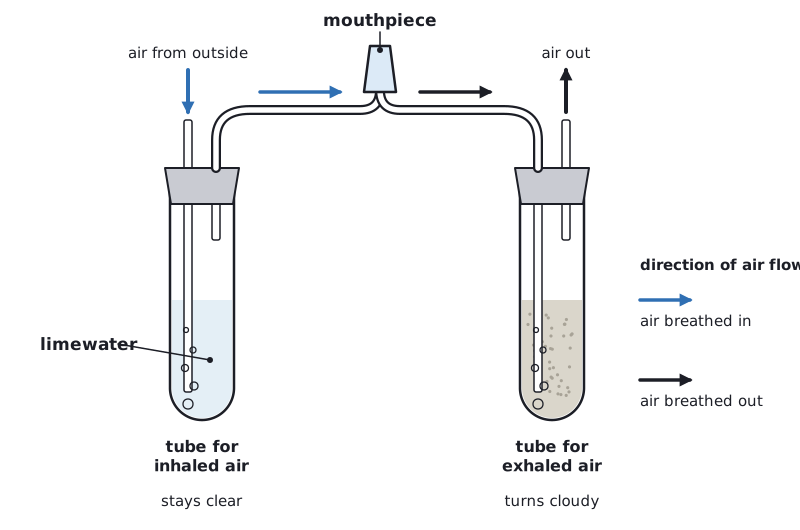
- Set up two boiling tubes, each containing the same volume of limewater (or hydrogen-carbonate indicator). Join them with tubing and glass tubes so that air breathed in comes through one tube and air breathed out goes through the other.
- Breathe gently in and out through a clean mouthpiece, so that you breathe in through the first tube and out through the second.
- Observe the limewater in each tube.
Limewater turns cloudy (milky) when carbon dioxide is present, and hydrogen-carbonate indicator turns from red/orange to yellow. The limewater in the tube for exhaled air turns cloudy much faster than in the tube for inhaled air, because exhaled air contains more carbon dioxide. This carbon dioxide comes from respiration in body cells.
The effect of exercise
- Sit still and count the number of breaths in one minute. Repeat and calculate a mean breathing rate at rest.
- Exercise for a set time, for example two minutes of stepping or running on the spot.
- Count the number of breaths in one minute straight away after exercise.
- Continue to record the breathing rate each minute until it returns to the resting rate.
Expected result: the breathing rate is higher after exercise and takes a few minutes to return to normal. Breathing is also deeper. Exercising muscles respire faster, so they make more carbon dioxide. Faster, deeper breathing removes the extra carbon dioxide and takes in more oxygen for respiration. If you breathe out through limewater or indicator after exercise, it changes faster than at rest.
| Type of variable | Example |
|---|---|
| Independent variable | Rest or exercise (or the length or type of exercise) |
| Dependent variable | Breathing rate, or time for the indicator to change colour |
| Control variables | Volume of limewater or indicator, same person, same type of exercise, same time of counting |
Never suck liquid back into your mouth: use a clean (disinfected) mouthpiece and tubes arranged so you cannot. Limewater is an irritant, so wear eye protection. Anyone with asthma or a medical condition should not do the exercise, and everyone should stop if they feel dizzy.
 (opens full size in a new tab)
Quick check
Name the muscles that contract when you breathe in.
Show answer
The intercostal muscles and the diaphragm.
What happens to the pressure in the thorax when you breathe in?
Show answer
It decreases, because the volume of the thorax increases.
Why are alveolus walls only one cell thick?
Show answer
To give a short diffusion distance so gases diffuse quickly.
Which substance in tobacco smoke combines with haemoglobin?
Show answer
Carbon monoxide.
What happens to limewater when carbon dioxide is bubbled through it?
Show answer
It turns cloudy (milky).
Written and checked against the Edexcel IGCSE Biology (4BI1) specification · Updated October 2026