
Book a tutor

Net gas exchange by day and night

Structure and functions in living organisms · Gas exchange in flowering plants · note 2 of 3

Spec 2.44B
Biology only (what this means)Biology only: only in International GCSE Biology. Double Award students can skip it. What the labels mean
Download all Gas exchange in flowering plants notes (PDF)Download all notes (PDF)6 pages

Net gas exchange by day and nightSpec 2.44B

In short

A plant respires all the time but photosynthesises only in light, so its net gas exchange changes with light intensity. In darkness and dim light it releases carbon dioxide. In bright light photosynthesis is faster than respiration, so it takes in carbon dioxide. At the compensation point the two rates are equal, so there is no net exchange.

A plant respires all the time. It photosynthesises only when there is light. This means that the net exchange of carbon dioxide and oxygen with the air changes with the light intensity.

Net gas exchange at different light intensities
LightRate of photosynthesis compared with respirationNet exchange of carbon dioxideNet exchange of oxygen
Darkness (night)No photosynthesis, only respirationCarbon dioxide releasedOxygen taken in
Dim lightPhotosynthesis slower than respirationCarbon dioxide releasedOxygen taken in
Compensation pointPhotosynthesis equals respirationNoneNone
Bright light (day)Photosynthesis faster than respirationCarbon dioxide taken inOxygen released

At the compensation point the carbon dioxide made in respiration is used up by photosynthesis, and the oxygen made in photosynthesis is used up by respiration. No gas moves in or out overall, but both processes are still happening.

As light intensity rises, the rate of photosynthesis rises while the rate of respiration stays about the same. A graph of net carbon dioxide uptake against light intensity therefore starts below zero (carbon dioxide released), crosses zero at the compensation point, then rises above zero.
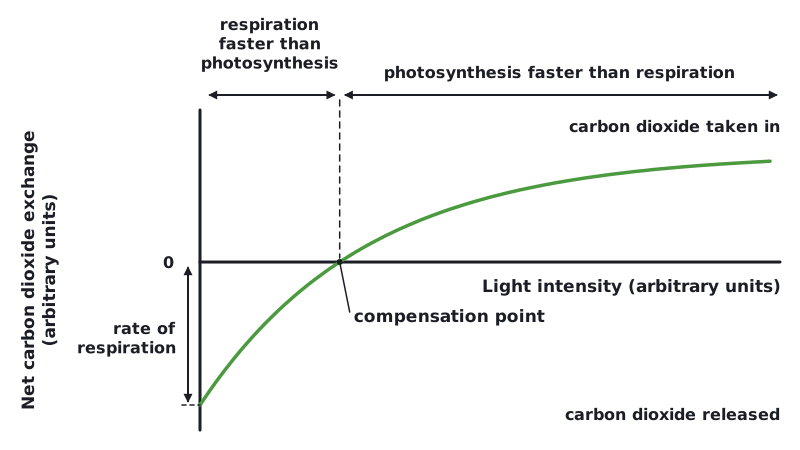
Graph of net carbon dioxide exchange against light intensity: the curve starts below zero in darkness, where the distance below zero is the rate of respiration, crosses zero at the compensation point and then levels off, with respiration faster than photosynthesis to the left of the compensation point and photosynthesis faster than respiration to the right. (opens full size in a new tab)
Below the compensation point the plant releases carbon dioxide; above it, the plant takes carbon dioxide in.
Exam tip:

Never say that plants only respire at night. They respire all the time. In the day the carbon dioxide from respiration is simply hidden by faster photosynthesis.

Written and checked against the Edexcel IGCSE Biology (4BI1) specification · Updated October 2026

Frequently asked questions

How do gases move into and out of a leaf?

Biology only Gases move into and out of a leaf by diffusion through the stomata, down their concentration gradients, so no energy is needed. In the day, carbon dioxide diffuses in because photosynthesis uses it up, lowering its concentration inside the leaf. Oxygen, a waste product of photosynthesis, diffuses out through the stomata into the air.

How do guard cells open and close stomata?

Biology only Guard cells open a stoma when they take in water and swell, and close it when they lose water and become limp. Open stomata let carbon dioxide in and oxygen out, but water vapour is also lost through them. The plant therefore closes its stomata when it is losing too much water.

Do plants respire at night and during the day?

Biology only Yes, plants respire all the time, in light and dark, but photosynthesise only when there is light. At night they release carbon dioxide and take in oxygen. In bright light photosynthesis is faster than respiration, so the carbon dioxide from respiration is used up and the plant takes in carbon dioxide overall.

All 5 questions on Gas exchange in flowering plants