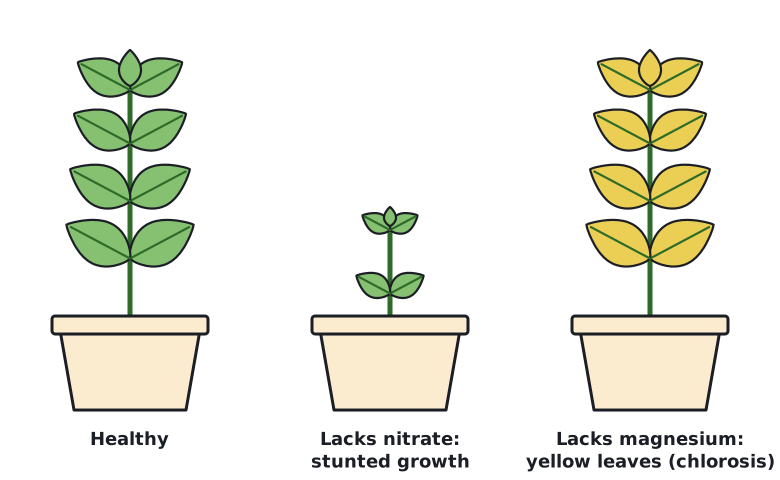
Plants need mineral ions, absorbed from the soil by the roots, for healthy growth. Magnesium ions are needed to make chlorophyll, so a shortage causes yellow leaves and slower photosynthesis. Nitrate ions are needed to make amino acids, which are joined to make proteins for growth, so a shortage causes stunted growth.
Plants need more than carbon dioxide, water and light. They also need mineral ions for healthy growth. The roots absorb these ions from the soil. You need to know two of them.
Two mineral ions that plants need
Mineral ion
Why the plant needs it
Effect of a shortage
Magnesium ions
Needed to make chlorophyll
Leaves turn yellow, because there is less chlorophyll
Nitrate ions
Needed to make amino acids, which are joined to make proteins for growth
Stunted (poor) growth
Without enough chlorophyll, a plant absorbs less light, so it photosynthesises more slowly and makes less glucose. Without enough amino acids, the plant cannot make the proteins it needs for new cells, so it grows slowly.
Link each ion to its job: magnesium goes with chlorophyll (yellow leaves), nitrate goes with amino acids and proteins (stunted growth). Do not say that plants use nitrate to make chlorophyll or glucose.
Written and checked against the Edexcel IGCSE Biology (4BI1) specification · Updated October 2026
Frequently asked questions
What are the limiting factors of photosynthesis?
The limiting factors of photosynthesis are light intensity, carbon dioxide concentration and temperature. A limiting factor is whichever is in shortest supply, so it stops the rate from going any faster. On a graph the rate rises while that factor limits it, then the line goes flat when a different factor becomes limiting.
How does light intensity affect the rate of photosynthesis?
As light intensity increases, the rate of photosynthesis increases, then levels off. Light provides the energy for the reaction, so at low light intensity the amount of light limits the rate. At high light intensity the rate stops rising because another factor, such as carbon dioxide concentration or temperature, has become the limiting factor.
How does temperature affect the rate of photosynthesis?
The rate of photosynthesis increases with temperature up to an optimum, then falls sharply. Photosynthesis is controlled by enzymes, so a higher temperature gives more collisions between enzymes and substrates. Above the optimum the enzymes are denatured because their active sites change shape, so the rate falls. Enzymes are not killed, because they are not alive.

 (opens full size in a new tab)